What Does *% Mean in a Turnitin AI Report? Every Score Explained
That asterisk isn't a glitch — Turnitin hides scores below 20% on purpose. Here's what every percentage range in a Turnitin AI detection report actually means, and what to do if your score comes back high.
You submitted your paper through your university's portal, and a few hours later the Turnitin AI report comes back with a strange result: *%. Not 5%. Not 12%. Just an asterisk. Or maybe you got a clean number — 34%, 61%, 82% — and you have no idea what that actually means for your academic standing.
This guide explains exactly what every percentage range in a Turnitin AI detection report means, why that asterisk exists, how reliable the scores are, and what you should do if your number comes back higher than you expected.
What does *% actually mean?
The asterisk — displayed as *% — appears whenever Turnitin's AI detection model calculates a score between 1% and 19%. Rather than showing you that number, Turnitin deliberately masks it and shows an asterisk instead.
The reason is reliability. According to Turnitin's own documentation, the false-positive rate rises sharply at lower score ranges — meaning the model is far more likely to flag genuinely human-written text as AI-generated when the score is below 20%. By replacing low scores with an asterisk, Turnitin is essentially telling you: “we detected something, but we don't trust this signal enough to give you a number.”
In practical terms, a *% result means one of the following:
- Your writing contains some patterns that mildly resemble AI-generated text, but not enough to be statistically meaningful
- You may have used AI for light editing, grammar checks, or paraphrasing on a small portion of the text
- Your natural writing style happens to produce smooth, consistent prose that the model notices but cannot confidently flag
A *% score is generally not a cause for concern. Most universities treat it as insufficient grounds for any formal action.
How Turnitin AI detection actually works
Turnitin's AI writing detector does not compare your text against a database of known AI outputs. Instead, it analyses the statistical properties of your writing. Large language models like ChatGPT, Gemini, and Claude generate text by always picking the most probable next word — which produces text that is unusually smooth, coherent, and predictable at a statistical level.
Turnitin's model looks for this smoothness. Human writing tends to be “burstier” — varying between complex and simple sentences, making unexpected word choices, and showing the kind of inconsistency that comes from a real person writing in real time. AI-generated text lacks this natural variation.
As of 2026, Turnitin runs three detection models simultaneously:
- Perplexity detection — flags text that is statistically “too smooth” for human writing
- AI-paraphrase detection — identifies text that was originally AI-generated and then run through a humaniser or paraphrasing tool
- Model-specific fingerprinting — detects characteristic patterns from specific LLMs including GPT-4o, Gemini 2.5, and Claude
The final percentage is a combined probability estimate from all three models. It represents the proportion of your “qualifying prose” — defined as long-form sentences in standard academic format — that the model believes may have been generated or significantly modified by AI.
What every score range means
Here is how to interpret each score band, based on industry guidance and Turnitin's own published materials:
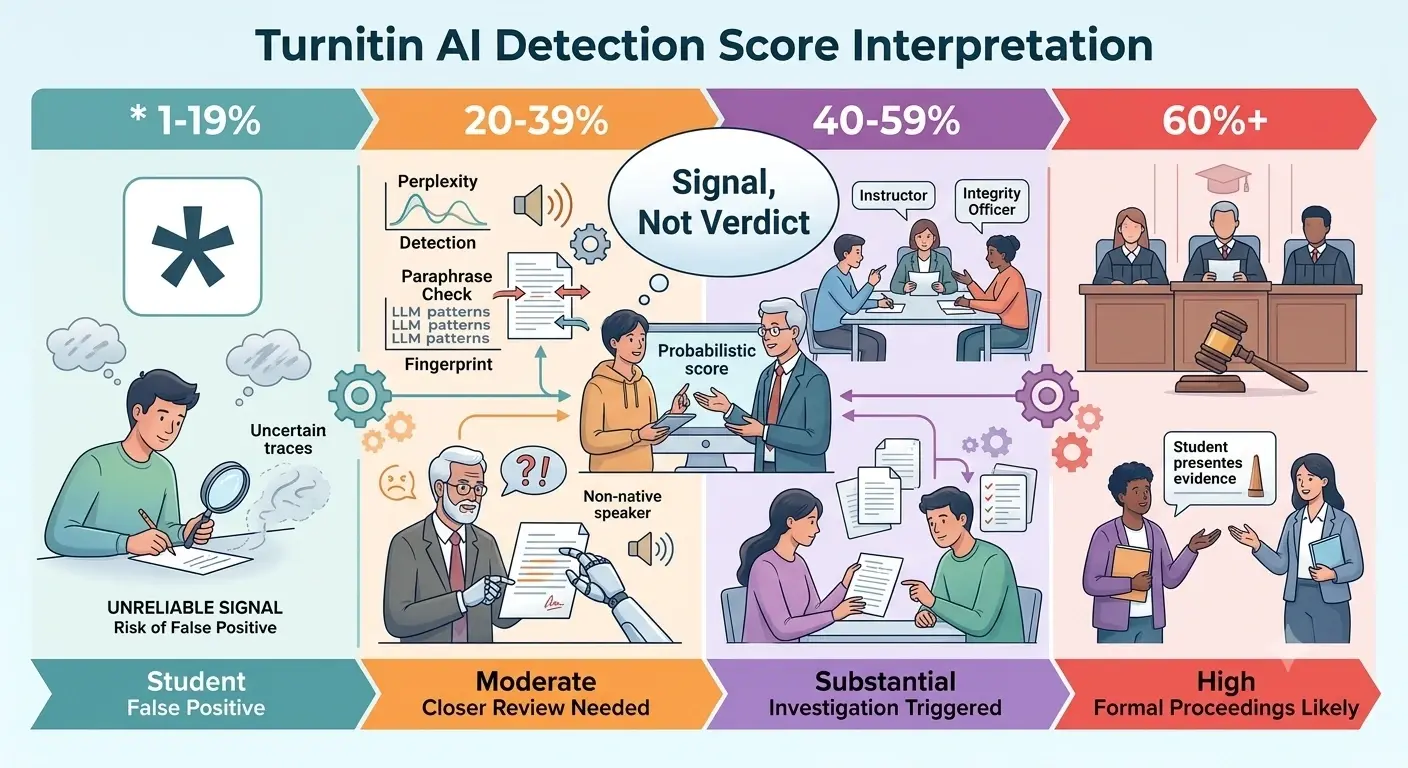
*% (0–19%) — Low signal, not displayed
Turnitin detected minor AI-like patterns but considers the signal too weak to quantify. This score is almost never acted upon formally. If you receive this result, your paper is unlikely to trigger any academic integrity process. Most institutions treat *% as a clean result in practice.
20–39% — Moderate, warrants closer reading
A score in this range means roughly one in five to two in five sentences show AI-like characteristics. This does not mean those sentences were written by AI — it means the model found them statistically consistent with AI output. Many institutions at this level will ask an instructor to manually review the flagged passages before taking any action.
This range is where false positives are most common. Non-native English writers, students who write in a formal academic register, and anyone who has used grammar tools like Grammarly are at higher risk of landing here without having used AI at all.
40–59% — Substantial, likely to trigger review
At this level, nearly half the qualifying text has been flagged. Most universities that actively use Turnitin AI detection will initiate some form of review at this threshold — typically a conversation with the student, a request for process evidence, or referral to an academic integrity officer. It is not automatic punishment; it is the beginning of an investigation.
60%+ — High, formal process likely
A score above 60% is where most institutions begin formal academic integrity proceedings. At this range, Turnitin's model is suggesting that a majority of the academic prose shows AI-like characteristics. If you receive a score in this range, you should begin gathering evidence of your writing process immediately — drafts, notes, browser history, timestamps.
It is worth noting that even a 90% score is not proof of AI use. Turnitin explicitly states that the score “should not be used as the sole basis for adverse actions against a student.”
How reliable is the score?
Turnitin claims over 98% accuracy with a false positive rate below 1%. Independent research paints a more complicated picture.
A peer-reviewed study found that Turnitin's AI detector produced false positives on 61.3% of TOEFL essays written by non-native English speakers — real, human-written academic work that was flagged as AI-generated. The reason is structural: formal English written by someone whose first language is not English tends to be more consistent, more grammatically careful, and less idiosyncratic than casual native writing. That consistency looks like AI to the model.
The problem is widespread enough that several major universities have disabled Turnitin's AI detection entirely:
- Vanderbilt University — disabled, citing reliability concerns and lack of transparency
- University of Waterloo — discontinued use in September 2025
- Curtin University — disabled across all campuses in early 2026
- Yale, Johns Hopkins, and Northwestern — all opted out of AI detection features
This does not mean the tool is useless — it means it should be treated as one signal among many, not as a verdict. As PlagAiReport explains, the asterisk threshold itself exists precisely because Turnitin's own research showed the tool was producing too many errors at lower score ranges.
What universities actually do with the score
There is no universal threshold. Different universities, faculties, and even individual instructors handle AI detection scores differently. Some use it as a conversation starter. Others have formal policies tied to specific score ranges. Many treat it as supplementary information rather than primary evidence.
What most leading institutions agree on in 2026 is that the AI detection score alone is not sufficient for disciplinary action. It needs to be combined with:
- The instructor's knowledge of the student's typical writing
- The nature of the assignment and whether AI use was prohibited
- Evidence of the student's writing process (drafts, outlines, revision history)
- A direct conversation with the student
What to do if your score comes back high
If your Turnitin AI report returns a score that triggers a review, here is what to do:
- Do not panic, and do not send an emotional email. Give yourself 24 hours before responding to any communication from your institution.
- Gather your process evidence immediately. Collect every draft, outline, note, and browser history tab that shows your work developing over time. Google Docs revision history is particularly useful — it timestamps every edit.
- Request the full report. Ask for the complete AI detection output showing which specific passages were flagged and at what confidence level. You have the right to see this.
- Check your course policy. Was AI use explicitly prohibited for this assignment? If the policy was vague or silent on the issue, that is relevant context.
- Request a human review. Put this in writing via email. Escalate to your academic integrity office or ombudsman if your instructor refuses to consider counter-evidence.
Turnitin's own guidance makes clear that the score is a probabilistic tool, not a lie detector. A student who can demonstrate their writing process — through drafts, notes, and timestamps — is in a strong position even against a high score.
Check your AI score before you submit
The most effective way to avoid this situation entirely is to know your score before your institution does. At AIPlagGuides, you can run your paper through Turnitin's official AI detection system — the same platform your university uses — before you submit. You get the real report, including the exact percentage and highlighted passages, delivered privately in minutes.
If your score comes back higher than you expected, you have time to review the flagged sections, adjust your writing, and resubmit the check — all before your actual submission goes in. A Turnitin AI Detection Report costs $2.40, or $2.70 bundled with a similarity report.
Frequently asked questions
Does *% mean Turnitin caught me using AI?
No. *% means Turnitin detected a very low-level signal that it does not trust enough to quantify. It is not a flag, and it is not a finding. Most universities treat it as a non-result.
Can my own writing produce a high AI score?
Yes. Formal academic writing, consistent sentence structure, careful grammar, and polished prose can all trigger the detector — especially if you are writing in English as a second language. The model is detecting statistical patterns, not reading your intentions.
Is 20% an acceptable score?
Generally yes, though there is no universal standard. Most institutions that have published guidance treat scores below 20–25% as low-risk. The asterisk threshold exists precisely because Turnitin considers scores below 20% too unreliable to act on.
Does the AI score affect my similarity score?
No. These are two completely separate systems measuring different things. Your similarity score measures how much of your text matches other sources in Turnitin's database. Your AI score measures statistical patterns in your prose. A paper can have a low similarity score and a high AI score, or vice versa.
Can I dispute a high AI score?
Yes. Gather your drafts and process evidence, request the full flagged report, and put your dispute in writing. Turnitin itself acknowledges the score is not proof of wrongdoing and explicitly states it should not be the sole basis for any adverse action.
Ready to check your paper?
Get your Turnitin report in minutes.
Same report your institution generates — delivered privately, fast.
Related articles