Can Turnitin Detect Self-Plagiarism? Yes — Here's How
Reusing your own previous essay can trigger a 70% similarity score on Turnitin. Here's how self-plagiarism detection works, when it applies, and how to reuse your own work without getting flagged.
You wrote the essay. It's entirely your own words, your own research, your own argument. But you submitted something very similar last semester — and now Turnitin has flagged a 70% match. This is self-plagiarism detection, and it catches more students off guard than almost any other similarity scenario. Here's exactly how it works, when it applies, and what you can do about it.
What is self-plagiarism?
Self-plagiarism — also called text recycling or double submission — is reusing your own previously submitted work without disclosure. This includes submitting the same essay to two different courses, recycling large sections of an old assignment into a new one, or building on a previous paper without telling your instructor.
The key distinction from regular plagiarism is intent: you're not stealing someone else's work. But the academic integrity concern is the same — you're presenting prior work as new, original effort produced for this specific assignment. Most institutions treat this as a form of academic misconduct regardless of who originally wrote the material.
How Turnitin detects self-plagiarism
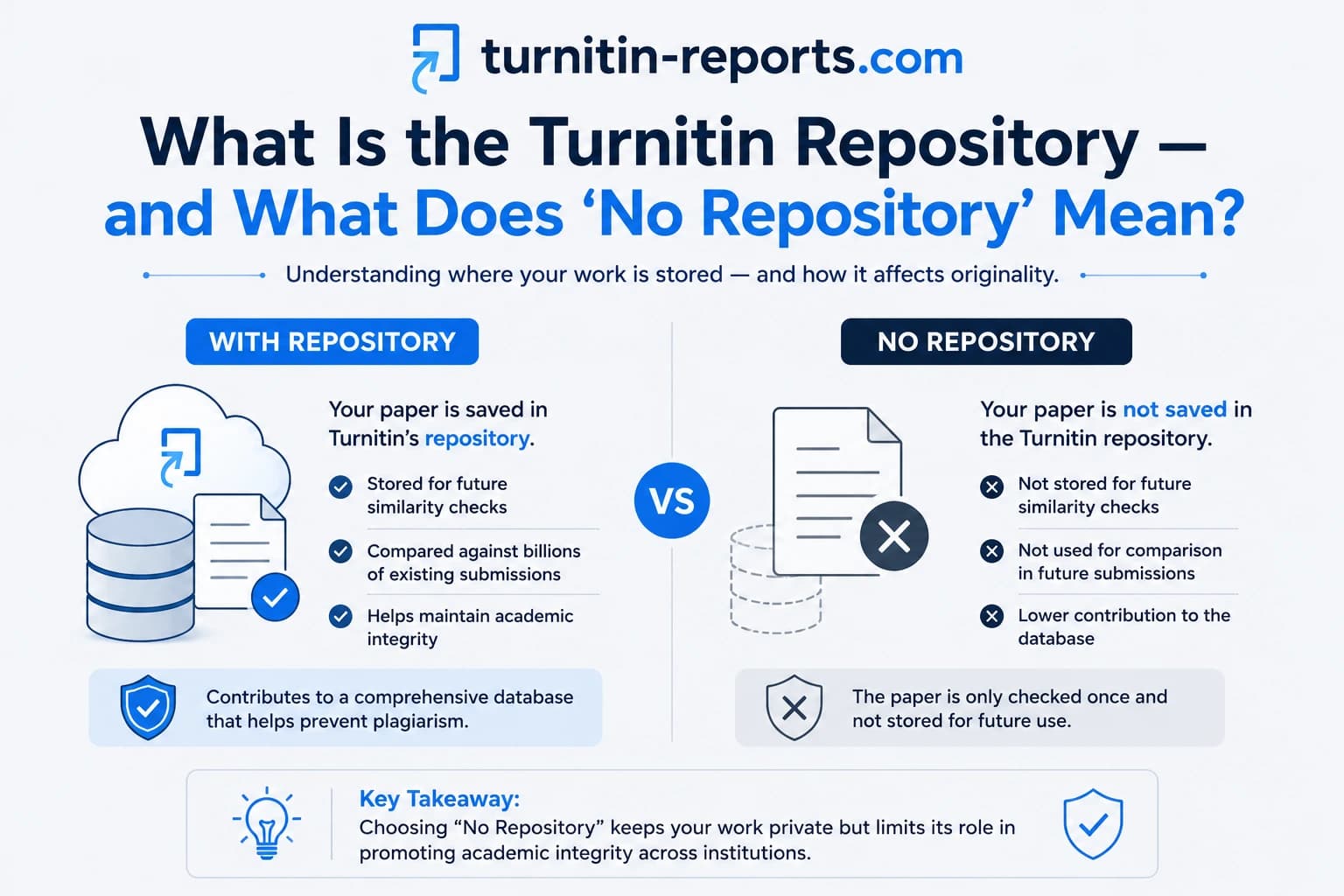
Turnitin's detection works through its student paper repository — a database of over 1.6 billion papers submitted through the platform by universities worldwide. When you submit a paper, Turnitin compares it against everything in this repository, including your own previous submissions.
If you submitted an essay in a first-year course and resubmit the same work — or a heavily overlapping version — in a second-year course, Turnitin will match it against your prior submission and flag the overlap in the similarity report. The match appears just like any other source match, except the source listed is your own earlier paper. Instructors can see this clearly.
In cases of complete resubmission, the similarity score can reach 100%. Even partial recycling — reusing an introduction, a literature review, or a methodology section — can push scores into ranges that trigger academic integrity reviews.
Turnitin's help documentation confirms this is an intentional feature: papers stored in the repository are checked against all future submissions, including from the same student.
When self-plagiarism gets flagged — and when it doesn't
Self-plagiarism detection depends entirely on whether your previous paper entered Turnitin's repository. A few scenarios where it may not be flagged:
- Your instructor used “No Repository” mode. If your previous assignment was submitted without being stored in Turnitin's database, there is nothing to match against. This setting is chosen by the instructor, not the student, and you typically cannot know which setting was used.
- Your previous institution didn't use Turnitin. Papers submitted through a different plagiarism tool at a different university are not in Turnitin's database.
- The overlap is minor. Small shared sections — a sentence or two of background context — may not trigger a significant match, though they will still appear in the report.
Conversely, self-plagiarism is almost certain to be flagged if your previous submission was stored in the repository and the overlap is substantial. Final submissions are particularly likely to be stored, as most institutions configure Turnitin to add final papers to the database by default.
How universities treat self-plagiarism
Most universities treat self-plagiarism as a breach of academic integrity, often applying the same disciplinary framework as regular plagiarism. The University of Arizona's academic integrity guidance describes self-plagiarism as submitting “the same work, or essentially the same work, for credit in two courses without the prior permission of the instructor.”
Consequences typically escalate with severity. A first offence may result in a zero on the assignment or failure of the course. Repeat violations can lead to academic probation, suspension, or in serious cases expulsion. The degree of overlap and the student's intent are usually considered before any penalty is applied.
Research suggests self-plagiarism accounts for around 9% of detected academic misconduct overall, rising to roughly 25% in disciplines like psychology where students frequently build on prior research across courses. It is not a rare edge case.
How to reuse your own work legitimately
Building on previous work is not inherently wrong — it becomes a problem only when it is undisclosed. Turnitin's own guidance on self-plagiarism outlines several approaches that keep you on the right side of academic integrity:
- Ask your instructor in advance. Many instructors will permit you to build on a previous assignment if you tell them upfront. Get this permission in writing.
- Cite your own prior work. If you are drawing on research or analysis you produced previously, cite it as you would any other source. This makes the reuse transparent and academically defensible.
- Keep new content dominant. A common informal guideline is to keep prior material to no more than 20% of the new submission, with at least 80% being genuinely new work. This is not a universal rule, but it reflects the expectation that each assignment represents new academic effort.
- Reframe rather than recycle. If you covered a topic in a previous course, approach it from a new angle, apply a different framework, or advance the argument further rather than resubmitting the same analysis.
Frequently asked questions
Can Turnitin match my paper against my own draft submissions?
Yes, if your drafts were stored in the repository. This is a known issue — students who submit multiple drafts of the same paper can see high self-match scores on their final submission. Instructors should configure draft submissions to avoid repository storage, but this is not always done. If you see a self-match on a final submission that reflects your own earlier drafts, explain this to your instructor.
What if I reuse my own work from a school that didn't use Turnitin?
If the previous paper was never submitted through Turnitin, it will not be in the repository and Turnitin will not flag it. However, your institution's academic integrity policy on self-plagiarism still applies regardless of whether the tool detects it. Submitting the same work without disclosure is still a policy violation even if the score comes back low.
Does self-plagiarism apply to personal statements or non-graded writing?
Self-plagiarism is specific to assessed academic work where originality is expected. Personal statements, blog posts, and non-graded reflections are generally outside the scope of academic integrity policies, though you should check your institution's specific rules.
Will my instructor know the match is from my own previous work?
Yes. The Turnitin similarity report identifies the source of each match. If the source is a paper you submitted previously, the report will show it as a match to that prior submission, making it clear to the instructor that the overlap is with your own work rather than someone else's.
Ready to check your paper?
Get your Turnitin report in minutes.
Same report your institution generates — delivered privately, fast.