Does Turnitin Detect AI Content Paraphrased by AI Humanizers?
AI humanizers promise to make ChatGPT output undetectable. Some reduce scores — most don't fool Turnitin entirely. Since August 2025, Turnitin can also tell when a humanizer was used. Here's what the evidence shows.
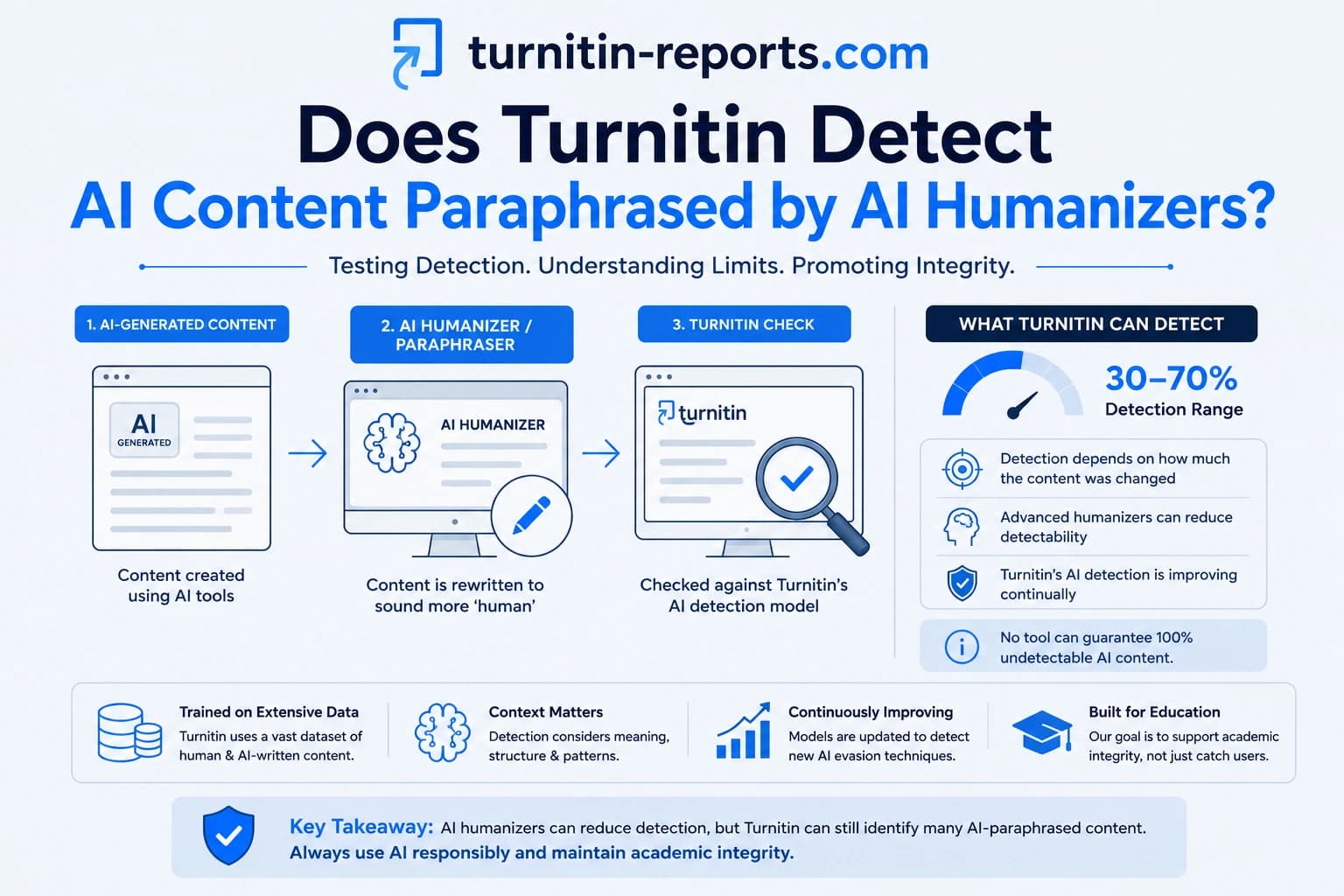
AI humanizers promise to rewrite ChatGPT output so that Turnitin cannot tell the difference. Some of them work — for now, partially, under certain conditions. Many of them do not. And since August 2025, Turnitin has added a detection layer specifically trained to identify the statistical fingerprints that humanizer tools leave behind. If it catches one, your report does not just say “AI detected.” It says “AI detected — and someone tried to hide it.”
Here is what the evidence actually shows about how well AI humanizers fool Turnitin, how Turnitin's detection works, and what the risks are for students who use these tools.
What AI humanizers actually do
AI humanizers — also called AI bypassers or AI word spinners — are tools designed to rewrite AI-generated text so it evades AI detection. They work by varying sentence structures, substituting synonyms, altering word order, and introducing the kind of small imperfections that human writing tends to have. Tools in this category include Undetectable.ai, HIX Bypass, QuillBot, StealthWriter, and BypassGPT, among many others.
The core problem is that most of these tools operate at the surface level. They swap words, rearrange phrases, and add stylistic noise — but they do not change the underlying structure of the text. And it is the underlying structure, not the word choices, that AI detection tools are primarily trained to identify.
Some humanizers perform badly enough that the processed output scores higher on AI detection than the original. Tools like Smodin and Phrasly have been independently tested and found to produce text that scores 100% AI-flagged across multiple detectors — worse than simply submitting the raw ChatGPT output. The tool creates its own detectable layer on top of the original AI layer.
How Turnitin detects AI — and why humanizers struggle to fool it
Turnitin's AI detection does not work by recognising specific phrases or matching against a database of known AI output. It analyses the statistical properties of the text itself, using two primary signals:
Perplexity measures how predictable each word choice is. Large language models pick the statistically most probable next word at every step — the result is text that flows smoothly but is mechanically predictable at the word level. Human writers make surprising, idiosyncratic choices. Turnitin's model is trained to identify that pattern of low perplexity across a document.
Burstiness measures variation in sentence length and complexity. Human writing is irregular — long complex sentences mixed with short ones, shifts in rhythm and tone. AI writing settles into a uniform cadence, often producing sentences in a consistent 18–24 word range. When three or more consecutive sentences fall within that pattern, Turnitin flags it.
Humanizers that simply swap words and rearrange phrases do not change either of these underlying signals. The predictability chains across a paragraph remain intact. The sentence rhythm remains uniform. Turnitin sees through the surface changes because it is not looking at the surface.
Turnitin has also trained its model to detect the specific structural patterns of AI academic writing — the rigid paragraph template of topic sentence, explanation, example, conclusion — and the unnaturally smooth transitions between paragraphs that AI consistently produces. Human writing has roughness. AI writing has cohesion that is too consistent to be natural.
Turnitin now has three detection layers targeting AI content
What has changed significantly since mid-2024 is that Turnitin no longer runs a single AI detection model. It now operates three overlapping systems.
The core model — AIW-2, deployed December 2023 — handles standard AI writing detection. It was trained on output from GPT-4, Claude, and Gemini and replaced the original model that only covered GPT-3 and GPT-3.5 output.
In July 2024, Turnitin launched AIR-1, a dedicated AI rewriting detection model trained specifically on text that had been processed through paraphrasing and humanizer tools. When both the core model and AIR-1 flag the same sentence, those sentences are highlighted in purple in the report — a separate colour from the standard AI flag — indicating AI-generated text that was then AI-paraphrased. Turnitin reports AIR-1 identifies AI-paraphrased sentences with 81.68% accuracy.
Then in August 2025, Turnitin added a fourth layer specifically targeting AI bypasser tools — trained on the statistical signatures of leading humanizers including Humbot, WriteHuman, and StealthWriter. Turnitin's Chief Product Officer stated: “Humanizers also leave a statistical trace that can be learned and detected.”
The practical consequence of this is significant: if you run AI output through a humanizer and submit it, Turnitin's report may now flag not just that AI was detected, but that an attempt was made to conceal the AI origin. That is a different finding from passive AI use — and institutions may treat it more seriously.
What the test data actually shows
Independent testing gives a clearer picture of where humanizers succeed and fail against Turnitin. The results vary considerably by tool and by how much post-processing is applied.
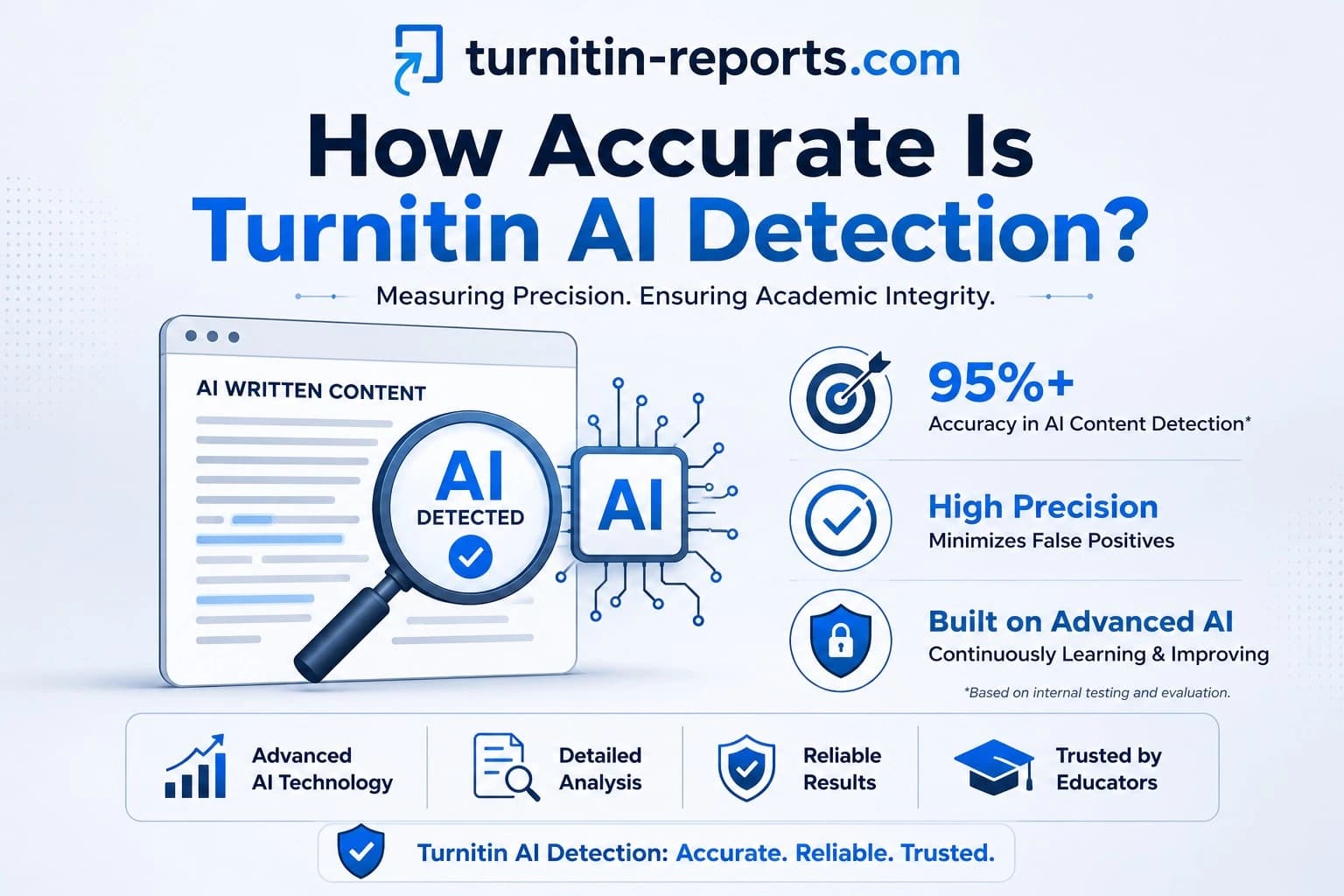
For unmodified AI text, Turnitin detects it at rates between 92% and 100% in independent testing — broadly consistent with its official 98% accuracy claim for longer documents.
QuillBot, the most widely used paraphrasing tool, brings the average Turnitin AI score on processed text down to around 41%. That sounds significant until you consider what it means in practice: only about one in four QuillBot-processed passages falls below Turnitin's 20% detection threshold. The other three in four are still flagged — and with AIR-1 active, those passages are also specifically highlighted as AI-paraphrased in purple.
More advanced humanizers perform better in raw detection terms, but the August 2025 bypasser detection layer complicates the picture for tools that Turnitin has specifically trained against. Independent testing found HIX Bypass still getting roughly 45% of processed content flagged post-update. StealthWriter scored 22% AI detection in some tests — better than most — but the paraphrasing flag still activates on detected sentences.
A systematic review published in the International Journal for Educational Integrity tested 14 AI detection tools and found that none could correctly classify all AI-generated documents that had undergone manual editing or machine paraphrasing — but Turnitin was the top-ranked tool overall, and accuracy dropped most sharply for all tools when text was manually edited by a human, not when it was processed by a humanizer.
The arms race — and why it has limits for students
The relationship between humanizer tools and Turnitin is often described as an arms race: humanizers evolve to evade detection, Turnitin updates its models to catch the new evasion patterns, humanizers adapt again. This framing is accurate, but it obscures something important for students.
The arms race happens at the tool level, not the student level. When Turnitin releases a new detection layer, every student using a humanizer that Turnitin has trained against is immediately more exposed — regardless of whether they knew the update had happened. Students do not get to update their submitted papers retroactively. And humanizer tools are not transparent about which detection systems they can currently evade: their marketing claims often lag their actual performance.
There is also a compounding academic integrity risk that is separate from whether detection works. Using a humanizer is not just using AI — it is using AI and then using another tool to try to hide it. In many institutional policies, active concealment is treated as a more serious offence than straightforward AI use. If Turnitin flags the paraphrase layer and your institution investigates, the report provides evidence not just of AI use but of a deliberate attempt to deceive.
What this means if you get flagged
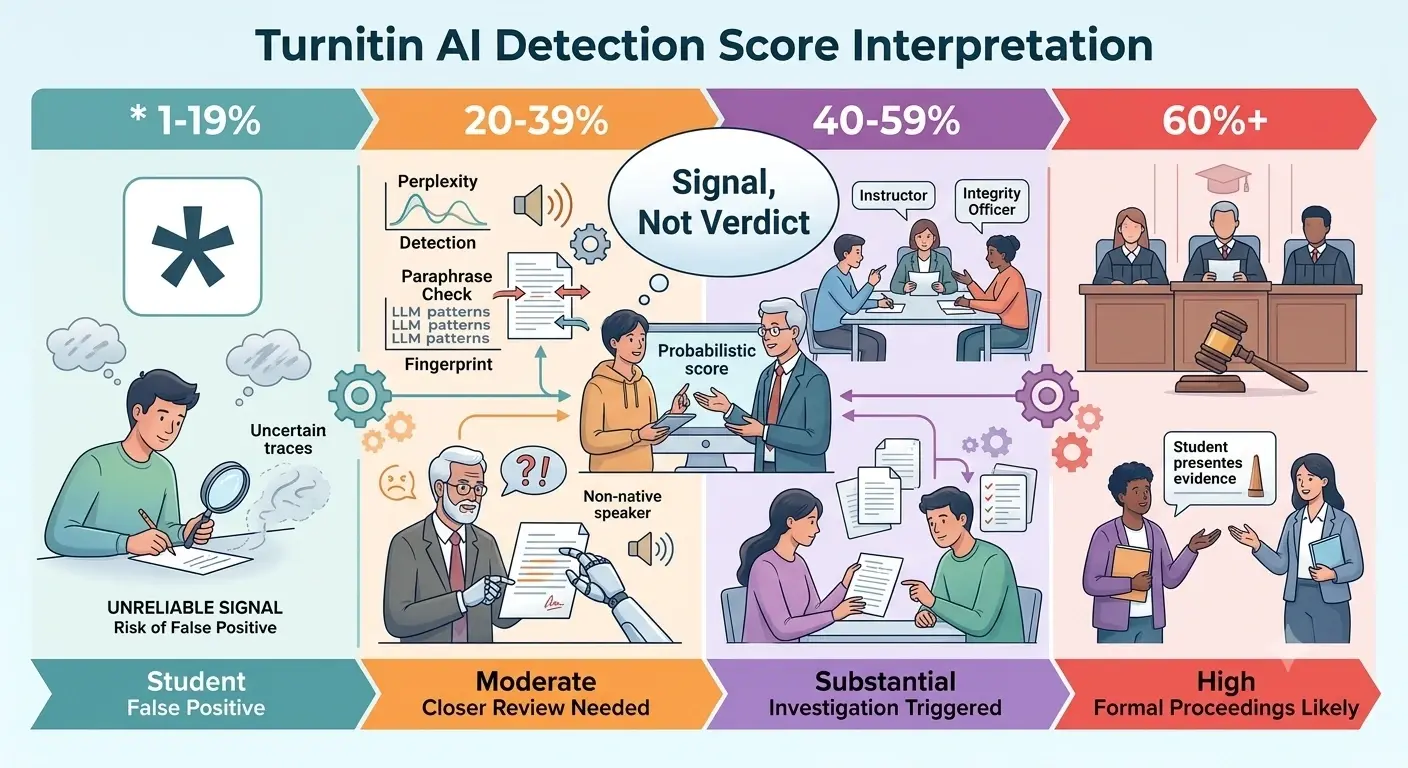
A high AI detection score — with or without the paraphrase flag — is not automatic proof of misconduct. Turnitin's own documentation states that the score “should not be used as the sole basis for adverse actions against a student,” and most reputable institutions require human review and a conversation before any disciplinary process begins.
If you receive a flag and you wrote the work yourself, gather your writing evidence: version history from Google Docs or Word, research notes, draft outlines, and timestamps. These show the development of the paper over time in a way that AI-generated content cannot replicate. Read our guide on how accurate Turnitin AI detection actually is for a full breakdown of false positive rates and what to do if you believe you have been wrongly flagged.
Frequently asked questions
Can AI humanizers fool Turnitin?
Some can reduce detection scores, but none reliably fool Turnitin entirely. Since August 2025, Turnitin has added a dedicated bypasser detection layer trained on the statistical signatures of leading humanizer tools. Even when the core AI detection score is reduced, the paraphrase detection layer may still flag the text — and show in the report that a humanizer was used.
Does QuillBot bypass Turnitin AI detection?
Partially. QuillBot-paraphrased AI text averages a 41% AI score on Turnitin, down from the 90–100% range for unmodified AI output. However, only about 25% of QuillBot-processed passages fall below Turnitin's 20% threshold. The majority are still flagged, and many will be highlighted in purple as AI-paraphrased text by Turnitin's AIR-1 model.
What does the purple highlight mean in a Turnitin AI report?
Purple highlighting was introduced with Turnitin's AIR-1 model in July 2024. It indicates sentences that were identified as both AI-generated and AI-paraphrased — meaning the text appears to have been produced by AI and then processed through a paraphrasing or humanizer tool. It is a separate flag from standard AI detection and signals an attempt to conceal AI use.
Is using an AI humanizer an academic integrity violation?
In most institutions, yes — using any AI tool to generate or substantially rewrite your work without authorisation violates academic integrity policy. Using a humanizer to then conceal that AI use can be treated as a more serious offence than straightforward AI use, as it constitutes active deception. Check your institution's specific policy before drawing any conclusions.
What humanizer tools does Turnitin specifically target?
Turnitin has publicly stated its bypasser detection was trained on tools including Humbot, WriteHuman, and StealthWriter. The company has not published a full list. Because detection is based on statistical signatures rather than tool names, any tool that leaves a detectable processing pattern — even one not on Turnitin's training list — may be flagged as the model continues to be updated.
Does Turnitin's AI detection affect similarity scores too?
No. AI detection and similarity detection are separate systems. Running text through a humanizer may lower your AI detection score (though not reliably), but it has no effect on your similarity score — which compares your text against Turnitin's database of web pages, journals, and student papers. For more on similarity scores, see our guide on understanding your Turnitin similarity score.
Ready to check your paper?
Get your Turnitin report in minutes.
Same report your institution generates — delivered privately, fast.