How Accurate Is Turnitin AI Detection? The Real Numbers
Turnitin claims 98% accuracy. Independent studies and a growing list of universities switching the tool off tell a more complicated story. Here's what the evidence actually shows.
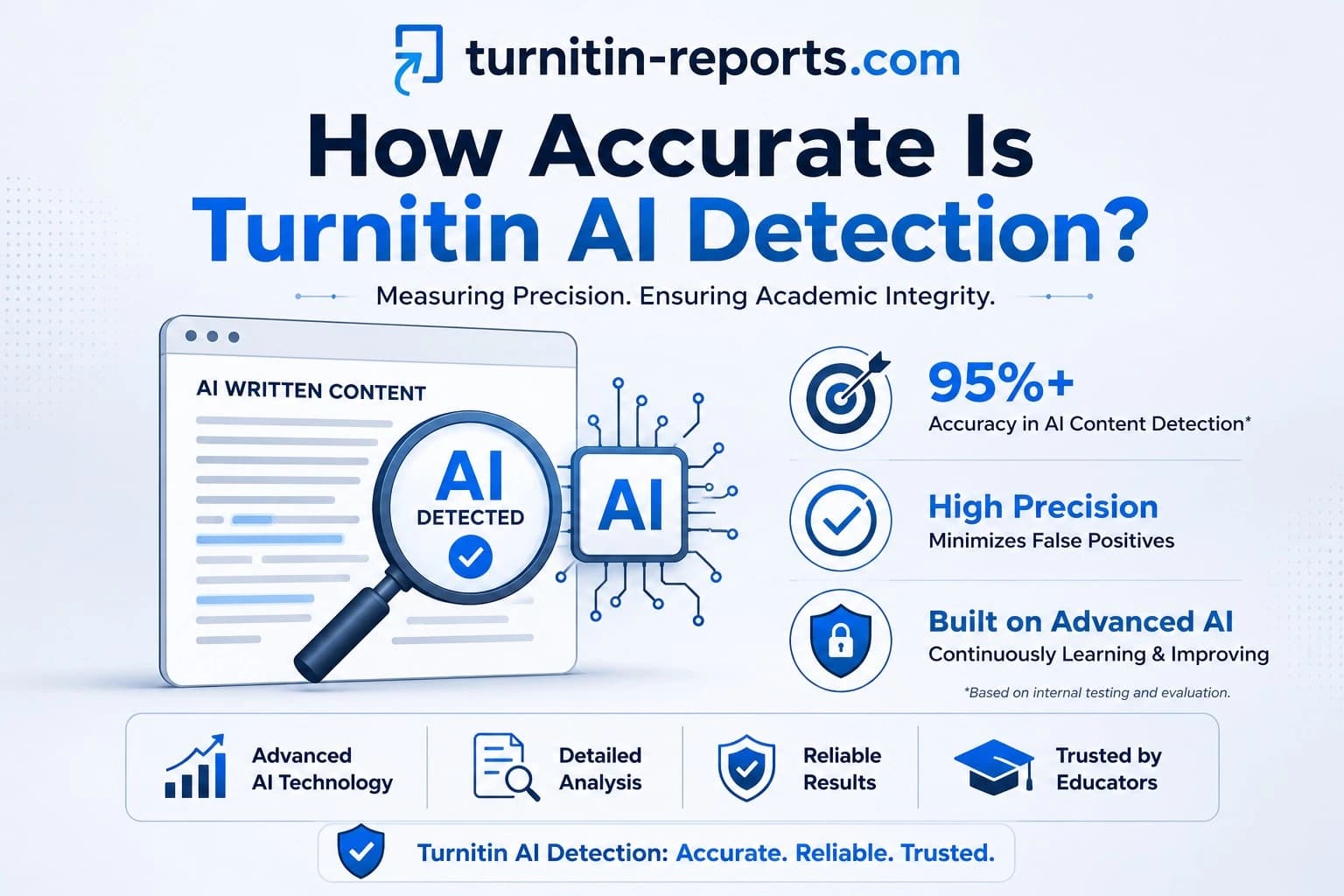
Turnitin says its AI detector is 98% accurate with a false positive rate below 1%. Universities have disciplined thousands of students based on those numbers. But a growing body of independent research — and a mounting list of universities quietly switching the tool off — tells a more complicated story.
This guide breaks down what Turnitin actually claims, what independent studies have found, which groups are most at risk of a false positive, and what you should do if your score comes back high.
What Turnitin officially claims about its accuracy
Turnitin's official position is that its AI writing detection model achieves approximately 98% accuracy with a false positive rate below 1%. These figures apply specifically to documents over 300 words that contain 20% or more AI-generated content.
That caveat matters a great deal. Turnitin is not claiming 98% accuracy across all submissions. It is claiming 98% accuracy on a subset — longer documents with a substantial amount of AI content. Shorter pieces, mixed human-AI writing, and heavily edited AI drafts fall outside the conditions where that claim holds.
Turnitin's Chief Product Officer was unusually candid about the trade-off in a public statement: “We estimate that we find about 85% of AI writing. We let probably 15% go by in order to reduce our false positives to less than 1 percent.”
In other words, the tool deliberately misses roughly one in seven AI-written papers in order to keep its false accusation rate low. That is a design choice, not a limitation being worked on — and it means Turnitin is not trying to catch everything.
Turnitin also states in its own documentation: “Our AI writing detection model may not always be accurate and should not be used as the sole basis for adverse actions against a student.” This disclaimer appears across Turnitin's help centre and product guides, yet it rarely makes it into the conversation when a student is called in for a meeting.
What independent research actually found
Several independent studies have tested Turnitin AI detection under real-world conditions, and the results diverge significantly from the official figures.
On unedited, clearly AI-generated text, independent testing generally puts Turnitin's detection rate between 90% and 96% — lower than the claimed 98%, but still broadly effective. The picture changes sharply once any human editing is involved.
When AI-generated text has been manually edited or paraphrased — which is how it would actually appear in a student essay — detection rates drop to somewhere between 40% and 70%, depending on how heavily the content was revised. One analysis found that unedited GPT-4 content was detected at around 96%, while the same content after moderate editing dropped detection to well below 70%.
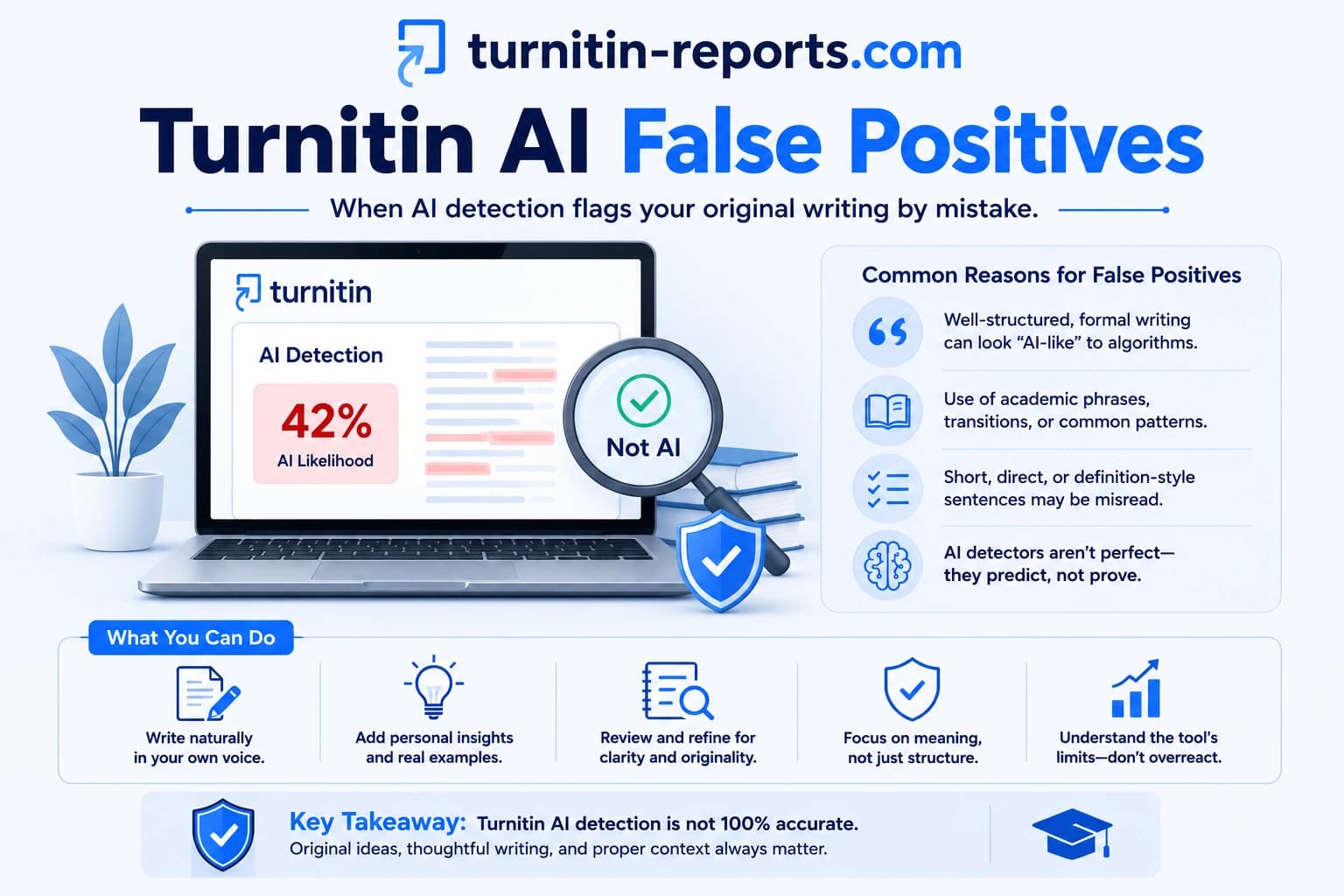
On false positives — incorrectly flagging human writing as AI — the independent picture is also more concerning than Turnitin's own figure. One analysis found a 4.2% false positive rate on genuinely human-written text, compared to the sub-1% Turnitin advertises. Turnitin itself acknowledges that approximately 4% of sentences in human-written documents are incorrectly flagged at the sentence level.
The sentence-level false positive rate matters because Turnitin does not assess documents as a whole — it analyses writing sentence by sentence and generates a percentage based on how many sentences it flags. A 4% sentence-level false positive rate means that even a completely human-written 500-word essay could have several sentences flagged, pushing the overall document percentage into a range that triggers concern.
The non-native English speaker problem
The most significant documented problem with Turnitin AI detection is its disproportionate impact on non-native English speakers. A Stanford University study tested seven widely-used AI detection tools — including Turnitin — against TOEFL essays written by Chinese non-native English speakers.
The result was stark: 61.2% of those essays were falsely flagged as AI-generated. The average false positive rate across all seven tools for non-native writers was 61.3%. For native English speakers tested under the same conditions, the false positive rate was near zero.
The reason is structural. AI writing detection tools identify AI-generated text by looking for low perplexity (predictable word choices) and low burstiness (uniform sentence length and rhythm). Non-native English writers naturally tend to use simpler vocabulary, shorter sentences, and more formulaic phrasing — exactly the characteristics that AI text shares and that the detectors are calibrated to find.
Turnitin disputes this finding. The company conducted its own testing on nearly 2,000 writing samples from English Language Learners and reported a false positive rate of 0.014% for ELL writers, compared to 0.013% for native speakers, concluding there was “no statistically significant bias.” Independent researchers have widely challenged that conclusion, pointing to the very different methodology used.
What is not disputed is that several universities — including Curtin University in Australia, which disabled the AI detection feature from January 2026 — have cited ESL bias as a direct reason for their decision.
The universities that have switched it off
One of the most telling signals about how universities view Turnitin AI detection is how many have quietly stopped using it. A growing number of institutions have disabled the AI indicator entirely, and most have given public reasons for doing so.
Vanderbilt University was one of the first. In August 2023, the university's academic technology team posted a detailed explanation of why they were disabling the tool. Their reasoning included a calculation: even accepting Turnitin's claimed 1% false positive rate, at their submission volume of approximately 75,000 papers, around 750 student papers could be incorrectly labelled as containing AI-written content. They concluded the risk to students was too high.
Curtin University (Australia) disabled the tool from January 2026, explicitly citing concerns about reliability and the potential for bias against ELL students.
Australian Catholic University had already moved away from the tool after multiple students were falsely accused through Turnitin flagging, leading to lengthy academic integrity investigations before the institution ultimately concluded the tool's output was not reliable enough to act on.
Other institutions — including several within the University of California system, Northwestern University, and the University of Pittsburgh — have similarly pulled back from using AI detection scores as actionable evidence, either disabling the feature or issuing guidance that the score alone cannot support a misconduct finding.
What the score is actually telling you
Turnitin AI detection does not make a binary call of “AI” or “human.” It analyses text at the sentence level and reports a percentage of sentences it believes were AI-generated. That percentage is then displayed on the AI writing report.
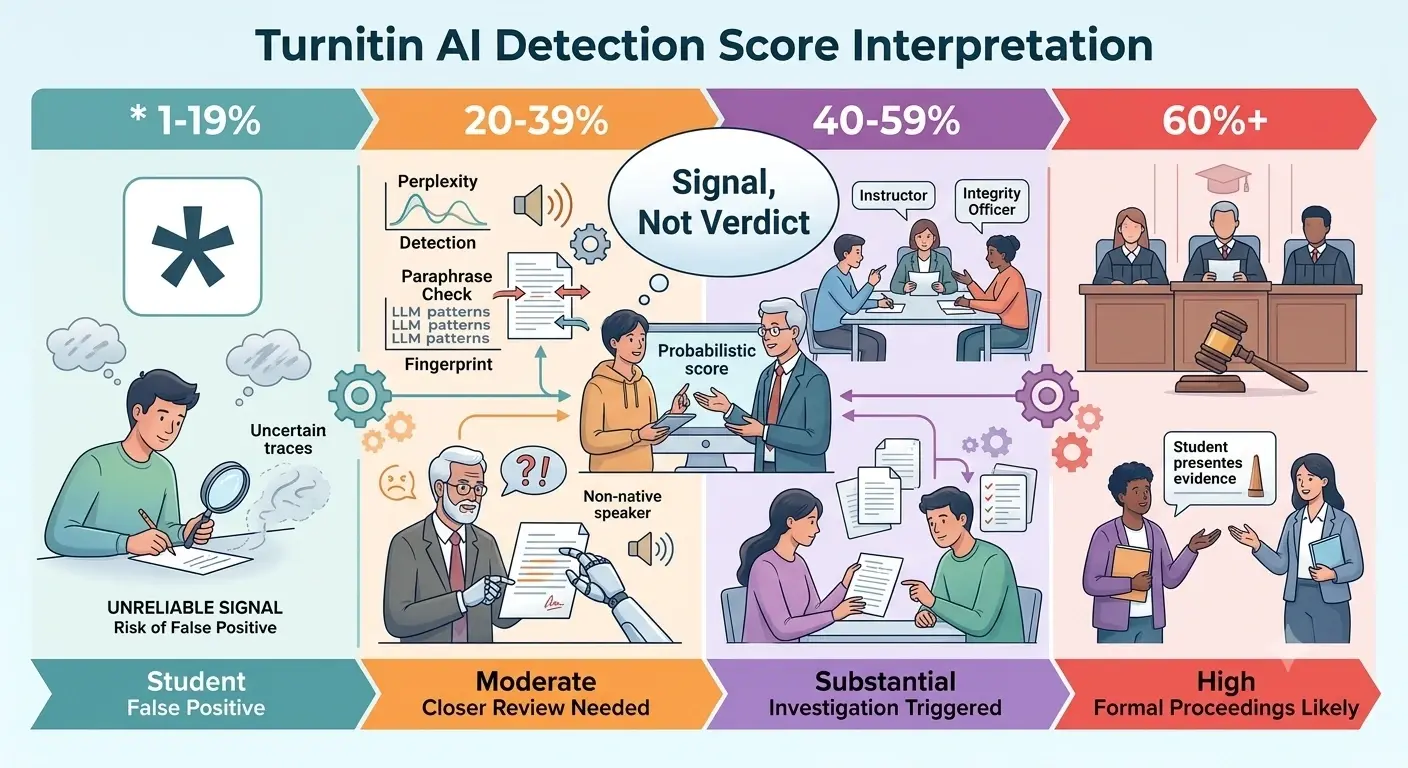
Scores below 20% are now shown as *% — a deliberate decision Turnitin made in July 2024 after concluding that low-range scores were too unreliable to display as specific numbers. The company acknowledged there was a “higher incidence of false positives” in the 1–19% range. In practice, this means Turnitin's own confidence in its detection drops significantly once you are below the 20% mark.
At 20% and above, the tool has higher confidence — but “higher confidence” is not the same as certainty. A score of 25% means that roughly one in four sentences in your document was flagged by a system with a known false positive rate. It does not mean one in four sentences was definitely written by AI.
Higher scores — 50%, 70%, 80% and above — reflect an increasing proportion of flagged sentences and are treated more seriously by institutions. But even here, Turnitin consistently instructs educators that the score is a signal to investigate, not a verdict.
For a full breakdown of what every percentage range means in the AI detection report, including the asterisk, read our guide on what *% means in a Turnitin AI report.
What affects whether the detection is accurate on your paper
Several factors influence how reliably Turnitin detects AI — and how likely a false positive is — on any given submission:
Document length. Turnitin's accuracy figures apply to documents over 300 words. Below that threshold, the detection becomes less reliable in both directions — more likely to miss AI content and more likely to flag clean human writing.
Writing style. Formal, structured academic writing — the kind taught in many university programmes — tends to share characteristics with AI-generated text. Clear topic sentences, parallel structure, consistent vocabulary, and measured sentence length are all features of good academic writing and also features that AI detection tools associate with AI output.
How much the AI content was edited. Unedited AI output is detected fairly reliably. Lightly edited AI output is less reliably detected. Heavily edited or paraphrased AI content is detected poorly. The gap between Turnitin's claimed accuracy and real-world accuracy largely comes from this editing variable.
The AI model used. Turnitin trains its detection on the AI writing tools available at the time of training. As new models emerge and existing ones evolve, detection rates shift. Turnitin updates its model periodically, but there is always a lag.
Grammar checking tools. There is some evidence that running text through grammar tools like Grammarly can alter phrasing in ways that increase AI detection scores. If you use these tools extensively, it is worth being aware of.
What to do if your score comes back high
A high AI detection score is not a conviction. Turnitin's own guidance — and an increasing body of legal precedent — makes clear that the score is a signal for further investigation, not proof of anything on its own.
In February 2026, a student named Orion Newby won what is believed to be the first federal lawsuit over a false AI plagiarism accusation, establishing that students are entitled to due process before any adverse action can be taken based on AI detection results. This case has made many institutions more cautious about acting solely on detection tool output.
If you receive a high score on a paper you wrote yourself, here is what to do:
Gather evidence of your writing process. Version history from Google Docs or Microsoft Word is the most useful evidence you can have. It shows the document developing over time, with edits, revisions, and timestamps that AI-generated content cannot replicate. Research notes, rough outlines, browser history, and draft screenshots all support your case.
Understand your institution's policy. Ask directly whether your institution uses the Turnitin score as definitive evidence or as a trigger for further review. Most reputable institutions have guidance that requires human judgment alongside any detection tool output. If yours does not, that is worth raising.
Know the published limitations. Turnitin's own documentation, the Stanford false positive research, and the decisions by Vanderbilt, Curtin, and others are all publicly available. If you are asked to respond to an accusation, referencing the published false positive rates — especially if you are a non-native English speaker — is entirely appropriate.
Ask for a human review. Request that your actual writing, your research trail, and your understanding of the material be assessed as part of any investigation. A conversation about the content of your paper — where the ideas came from, what sources you used, how you structured your argument — is evidence that no detection tool can replicate.
Check your AI score before your institution does
The most effective thing you can do with any detection tool — Turnitin's included — is see your score before your lecturer does. If your paper is clean, you confirm that and submit with confidence. If something comes back flagged that you did not expect, you have time to understand why and, if appropriate, to revise.
AIPlagGuides gives you access to the same AI detection report your institution generates — the actual Turnitin output, not a third-party approximation. You upload your document, receive the report in minutes, and your file is never stored. From $2.40 for the AI detection report alone, or $2.70 for both the AI and similarity reports together.
Knowing your score in advance does not change what Turnitin detects. But it gives you time to understand the result, gather your writing evidence, and walk into submission — or any subsequent conversation — fully informed.
Frequently asked questions
Is Turnitin AI detection reliable?
It is partially reliable. On clearly AI-generated text over 300 words, Turnitin detects AI at around 90–96% accuracy in independent testing. On edited AI content, detection rates fall significantly. False positives on human writing — particularly from non-native English speakers — are documented and acknowledged. Turnitin itself advises that the score should not be used as the sole basis for any adverse action.
Can Turnitin falsely accuse you of using AI?
Yes. Turnitin acknowledges a sentence-level false positive rate of approximately 4%. Independent studies have documented false positive rates significantly higher than Turnitin's own claimed sub-1% document-level figure, particularly for structured academic writing and non-native English speakers. A false positive is a real and documented risk.
Does Turnitin AI detection work on ChatGPT?
For unedited ChatGPT output, detection rates are reasonably high — around 90–96% in independent testing. Turnitin trains its model on available AI writing tools and updates it periodically. However, any manual editing of the output reduces detection reliability, and heavily paraphrased AI content may not be detected at all.
Why have some universities stopped using Turnitin AI detection?
Several universities — including Vanderbilt, Curtin University, and Australian Catholic University — have disabled the AI detection feature citing concerns about false positive rates, potential bias against non-native English speakers, and the risk of wrongly accusing students. Some have concluded the tool is not reliable enough to use as evidence in academic integrity proceedings.
What score on Turnitin AI detection is considered high?
Scores below 20% are now displayed as *% by Turnitin, which the company itself acknowledged carries a higher rate of false positives. Scores of 20% and above are shown as specific numbers. What constitutes a “high” score that triggers an investigation varies by institution — some act on 20%, others only at 50% or above. Check your university's academic integrity policy for their specific threshold.
Can you appeal a Turnitin AI detection result?
Yes. A Turnitin AI score is not final proof of anything. Most institutions have an academic integrity appeals process where you can present evidence of your writing process, question the reliability of the tool, and request a human assessment of your work. Bring version history, drafts, research notes, and any relevant documentation about false positive rates if you are a non-native English speaker.
Ready to check your paper?
Get your Turnitin report in minutes.
Same report your institution generates — delivered privately, fast.