Does Turnitin Detect Paraphrased Text From Journal Articles?
Turnitin has full-text access to more than 78 million scholarly items through Crossref's Similarity Check programme — including paywalled Elsevier, Wiley, and Springer articles — and its n-gram matching flags paraphrases that keep technical terminology or sentence structure intact. Here is why journal paraphrasing is uniquely hard to disguise.
Paraphrasing a journal article is one of the most common tasks in academic writing — and one of the most nervy places to sit in a Turnitin report. Students routinely ask whether a rephrased sentence from a peer-reviewed paper can still trigger a match. The short answer: yes, it can, and journal articles are actually one of the categories Turnitin is best positioned to detect paraphrasing from. Here is why, and what “enough of a rewrite” actually looks like when the source is a research paper.
What journal content Turnitin can actually see
Turnitin's reach into the academic literature is broader than most students assume. Its access to journal articles comes primarily through Crossref's Similarity Check programme, in which participating publishers contribute the full text of their articles to Turnitin's database in exchange for reduced-cost access to the checking service. The Similarity Check corpus currently contains over 78 million full-text scholarly content items and is updated daily via Crossref's metadata feed.
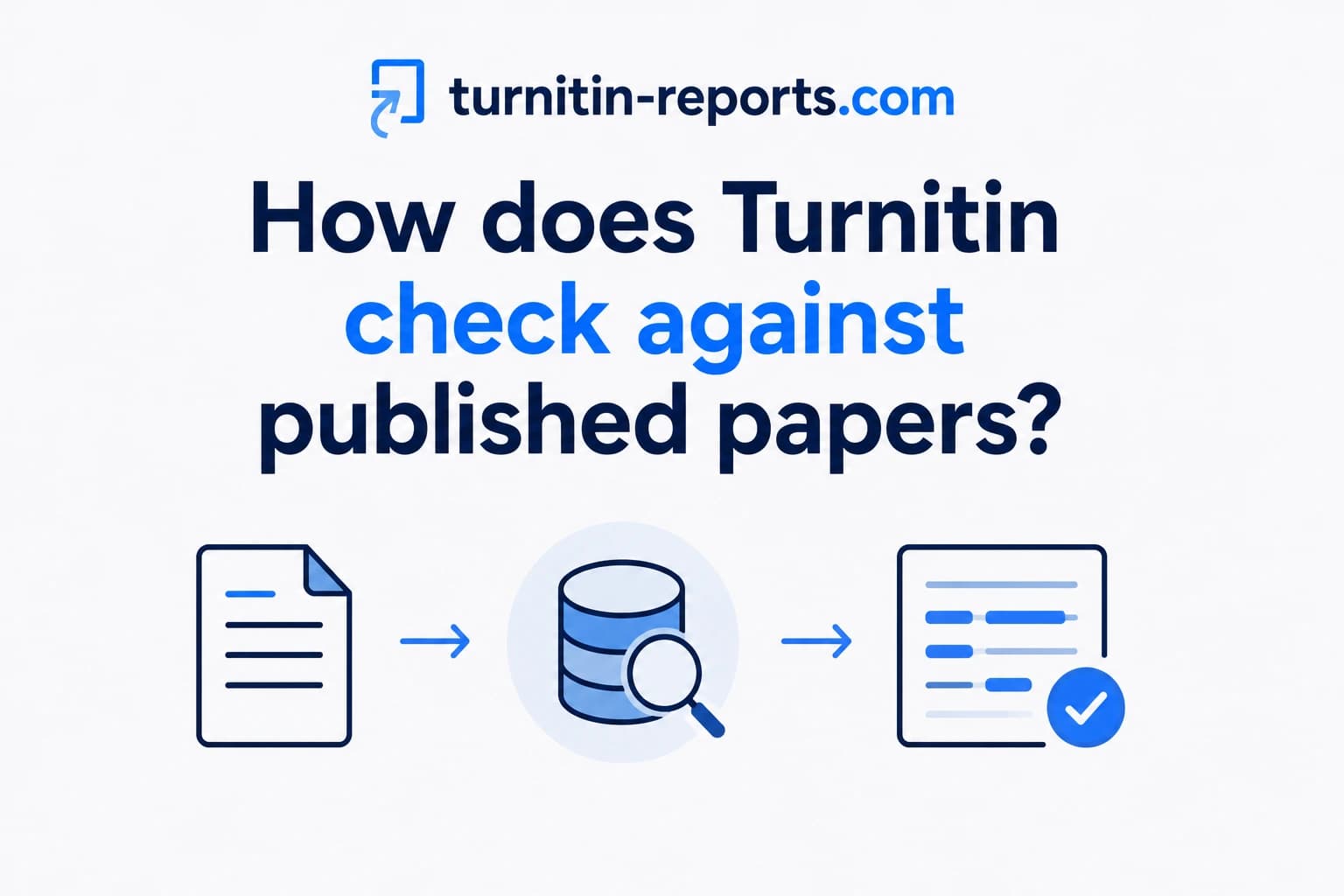
Almost every major academic publisher participates: Elsevier, Wiley, Springer Nature, Taylor & Francis, SAGE, Oxford University Press, Cambridge University Press, IEEE, and hundreds of smaller society publishers. Turnitin also indexes content from open repositories like arXiv, bioRxiv, SSRN, PubMed Central, and institutional repositories that expose full-text theses and dissertations. ProQuest — Turnitin's parent company since 2019 — supplies a dissertations and theses database on top of that. Our guide on how Turnitin checks against published papers covers the plumbing in detail, but the practical takeaway is that paywalled content is not hidden from Turnitin. If your source has a DOI, assume the full text is indexed.
How Turnitin matches text — the n-gram core
The Similarity Report is powered by string matching, not by any human-like reading of meaning. Turnitin fingerprints your submission by breaking it into overlapping n-grams — short sequences of consecutive words — and comparing those fingerprints against the n-grams in its index. When enough consecutive matches line up, that passage is flagged and coloured in the report. Turnitin's own documentation confirms it typically flags runs of roughly eight or more consecutive matching words, though the exact threshold is adaptive and can catch shorter distinctive phrases.
This matters for paraphrasing because n-gram matching does not care about your intent — it cares whether the exact sequence of words in your sentence exists somewhere in the database. If a paraphrase leaves a five- or six-word phrase from the original intact — a technical term, a definition, a distinctive noun phrase — that stretch will still light up. Our post on what Turnitin actually checks walks through how the matching engine constructs its comparison pool.
Why journal paraphrasing is uniquely hard to disguise
Web content is easy to paraphrase because it is written in general vocabulary that has hundreds of synonyms. Journal articles are the opposite. They are dense with terminology that has no acceptable substitute: you cannot rename “mitochondrial membrane potential,” “statistically significant at p < 0.05,” or “the null hypothesis” without either misrepresenting the science or producing text that reads as gibberish. Any competent paraphrase of a research paper will retain the field's technical lexicon — which means the n-gram matches survive the rewrite.
On top of that, academic writing has a highly conventional structure. Methods sections describe procedures in a near-standardised sequence. Results are reported in fixed phrasings (“we observed a significant increase in…”, “there was no correlation between…”). Discussion sections cite prior literature in patterns that are hard to reorder. Even when you rewrite every sentence, the sequence of ideas and the phrasing scaffolding around technical terms tends to snap back to something very close to the original.
Semantic matching vs exact text matching
A common misconception is that Turnitin's Similarity Report performs semantic analysis — that it “understands” meaning and can match rephrased ideas independently of the words used. The Similarity Report itself is predominantly text-based. It relies on n-gram fingerprinting, with some tolerance for minor edits (small word insertions, plural changes, punctuation differences), but it does not build a semantic representation of your argument and compare it to a semantic representation of the source.
Where semantic analysis does enter is in Turnitin's AI Writing Report, which is a separate system launched in April 2023 and upgraded in December 2023 with the AIW-2 model. That system uses statistical properties of prose — perplexity, burstiness, and semantic embeddings — to flag AI-generated and AI-paraphrased text. It runs in parallel with the Similarity Report but is not the same thing. Our guide on how Turnitin's AI detection works explains that split in detail.
For a straight paraphrase of a journal article that you wrote yourself, the Similarity Report is what you should be worried about — and it is looking for word sequences, not ideas.
Paraphrasing tools trigger the AI report as well
If you paraphrase by hand, only the Similarity Report is in play. But the moment you feed a passage through QuillBot, Wordtune, Spinbot, or ChatGPT's “rewrite” function, the AI Writing Report becomes relevant too. Turnitin's AIW-2 model was specifically trained to detect AI-paraphrased text — passages that were AI-generated or AI-rewritten and then lightly re-edited. Documentation from Turnitin reports that AIW-2 catches AI-paraphrased content at an 85.22% sentence-level recall rate, and the report flags this content with a distinctive purple highlight to distinguish it from purely AI-generated cyan-highlighted text. See our breakdown on whether Turnitin detects QuillBot for what the current pass rates look like.
The awkward outcome many students encounter: paraphrasing software lowers the similarity score (fewer verbatim n-gram matches) while raising the AI score (statistical fingerprints of AI rewriting). An instructor looking at both reports side by side sees the swap immediately.
Paraphrasing patterns that do not work
Three approaches routinely fail against a well-indexed journal article:
- Synonym substitution. Swapping “shows” for “demonstrates” or “important” for “significant” while leaving the sentence structure intact leaves long strings of the original in place — especially the technical noun phrases that carry the meaning. The n-gram fingerprint is largely unchanged.
- Sentence reordering. Flipping clause order (“Because X, Y happened” becoming “Y happened because X”) rearranges the surface but keeps the same words in near-identical local sequences. Turnitin's adaptive matching handles this trivially.
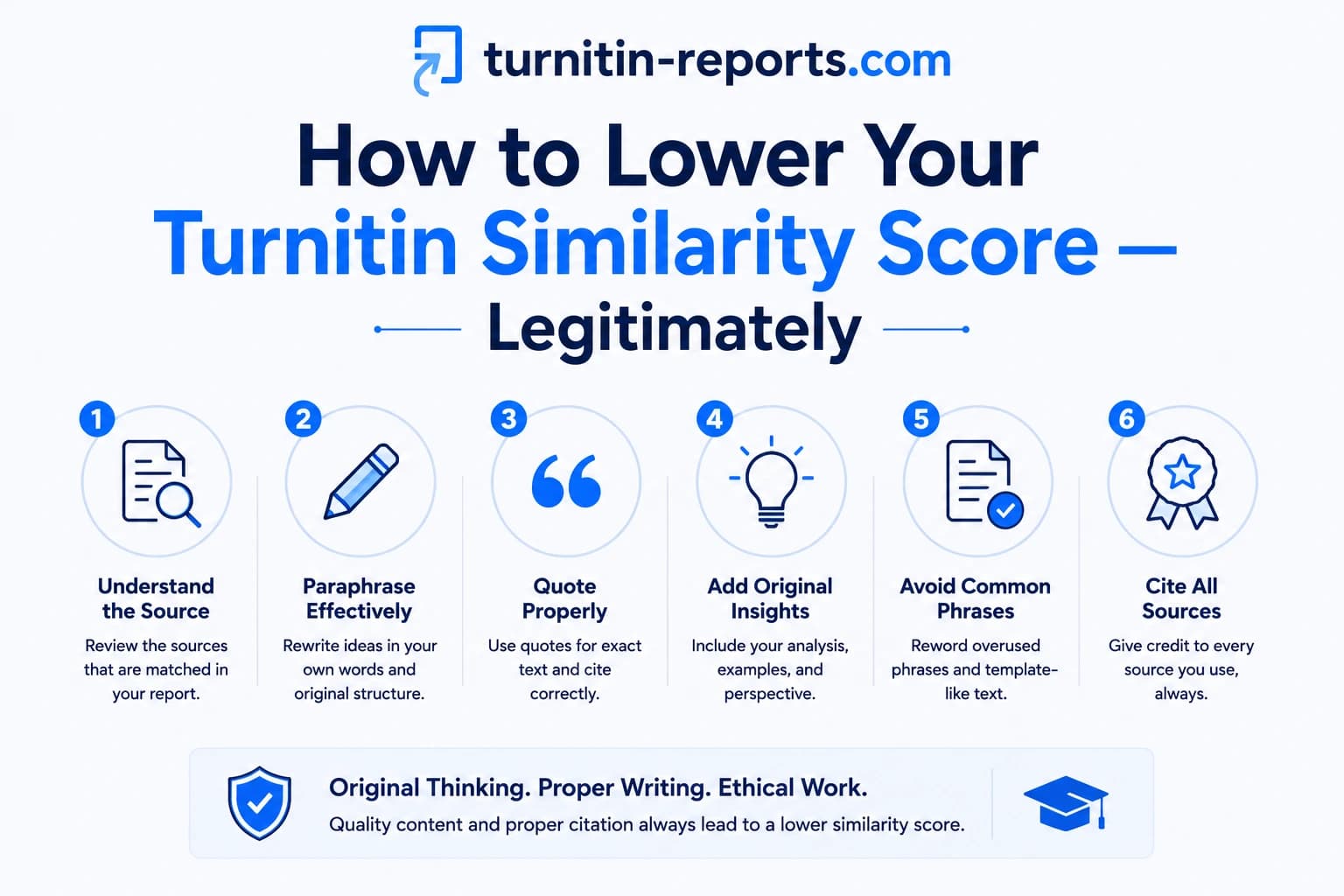
- “Copy, then edit” drafting. Pasting a paragraph in and editing it word by word is the single most common source of accidental plagiarism. It anchors the writer to the original sentence architecture. If you have already tried this and the report came back messy, our guide on how to lower your Turnitin similarity score covers the recovery workflow.
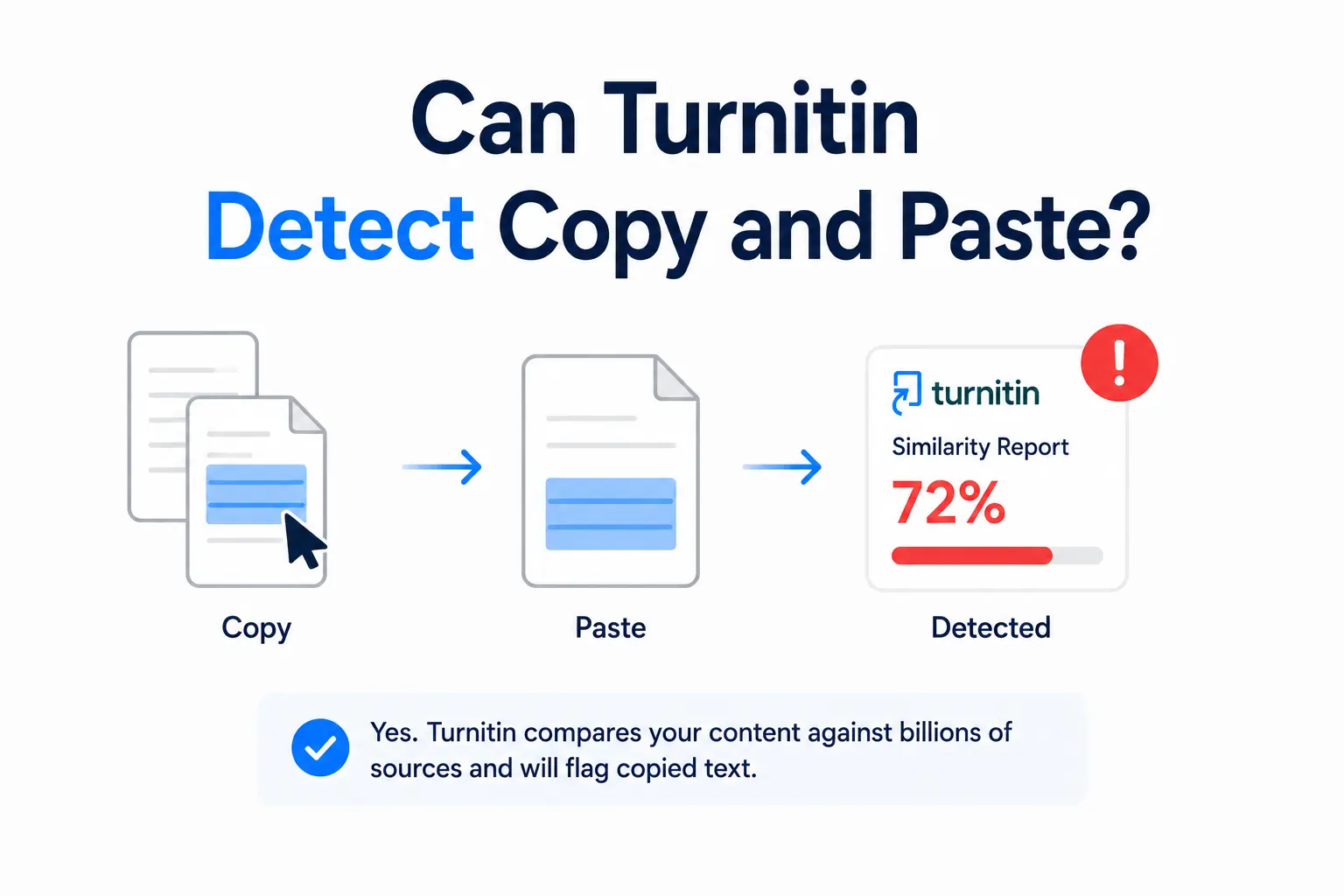
The same “copy-then-edit” pitfall applies to direct pastes from PDFs of the article — see our post on whether Turnitin detects copy-paste for how the report exposes that pattern.
Paraphrasing patterns that actually work
Research on paraphrasing effectiveness — including work summarised in the International Journal for Educational Integrity — converges on the same conclusion: the paraphrases that survive detection are the ones where the writer has genuinely internalised the source and rebuilt the point from scratch. In practice that looks like:
- Read, close the source, then write. Once you have the tab shut, your working memory forces you to reconstruct the idea using your own sentence architecture. When you re-open the source afterwards to check accuracy, the phrasing is already yours.
- Change the structural unit. If the source explains a mechanism in three sentences, explain it in one — or in five. Compression and expansion both destroy the n-gram fingerprint far more effectively than word substitution.
- Integrate multiple sources into a single paragraph. Synthesis (“Smith found X, while Jones observed Y — together suggesting Z”) produces text that cannot match any single source because the sentence itself is a new construction.
- Anchor with your own example or analogy. Attaching a source's finding to a case, dataset, or comparison of your own forces the surrounding prose into original phrasing.
- Keep quoted technical terms genuinely quoted. If a phrase cannot be reworded without distorting meaning — a legal term of art, a specific statistical test, a named theory — put it in quotation marks and cite. Excluded quotations do not contribute to the score.
How much do you need to change?
There is no official threshold, but the working rule that maps onto Turnitin's matching behaviour is this: no run of more than about seven consecutive words should match the original, and the sentence-level structure should not mirror the source. If both conditions are met, the passage will typically not register in the Similarity Report even against a fully indexed journal article. If either fails — a long technical phrase copied verbatim, or a sentence that follows the same clausal skeleton — expect a partial match.
This is also why the similarity score is a poor proxy for how well you have paraphrased. A single unrewritten definition can push a paragraph into the report; a well-rewritten five-page section may contribute nothing. Our post on understanding the similarity score explains why the source breakdown, not the top-line percentage, is what actually matters.
The tension between paraphrasing and detection
Paraphrasing is required by every academic writing style guide — the APA Style guide, the Purdue OWL, and every university writing centre agree that paraphrasing with citation is preferable to over-quoting. Yet Turnitin flags similar phrasing regardless of whether it is properly cited. That tension is not a flaw in the system; it is by design. Turnitin does not judge whether a match is legitimate or problematic — it surfaces the overlap and leaves the interpretation to the instructor, who applies the exclusion filters (bibliography, quotes, small matches) and reads the source breakdown.
The practical implication is that a paraphrase from a journal article will often produce a small amount of flagged text in the report even when the citation is impeccable. That is not a failure. What matters is whether the flagged passages are attributed, whether they represent genuine synthesis, and whether the paper as a whole reads as your own reconstruction of the literature rather than a lightly reworded lift from one source.
Frequently asked questions
Does Turnitin detect paraphrased text from journal articles?
Yes, in many cases. Turnitin has full-text access to over 78 million scholarly items through Crossref's Similarity Check programme, including paywalled articles from Elsevier, Wiley, Springer, and most major publishers. Paraphrases that keep the source's technical terminology, sentence structure, or long word sequences will still produce partial matches through Turnitin's n-gram matching. Only paraphrases that genuinely reconstruct the argument in original phrasing and structure typically avoid detection.
Does Turnitin do semantic analysis on paraphrases?
The Similarity Report itself is predominantly text-based — it matches word sequences rather than meaning. Semantic analysis is used in Turnitin's separate AI Writing Report, particularly the AIW-2 model launched in December 2023, which is designed to detect AI-paraphrased content. For a hand-written paraphrase of a journal article, the Similarity Report is what applies, and it is looking for word-sequence overlap.
How much do I need to change to avoid a Turnitin match?
As a working rule, no run of more than about seven consecutive words should match the source, and your sentence structure should not mirror the original. Synonym swaps within a matching sentence skeleton are not enough. Effective paraphrasing typically requires reading the source, closing it, and reconstructing the idea from memory in your own phrasing — often integrating multiple sources into one passage.
Does using QuillBot or another paraphrasing tool on a journal article help?
It may reduce the similarity score but will typically raise the AI score, because Turnitin's AIW-2 model is specifically trained to detect AI-paraphrased text and flags it with a distinctive purple highlight. That combination — falling similarity score, rising AI score — is a common pattern that instructors recognise immediately. Hand-paraphrasing is the safer route.
Ready to check your paper?
Get your Turnitin report in minutes.
Same report your institution generates — delivered privately, fast.