Inside Turnitin's AI Detector: How the Model Actually Works
Turnitin's AI Writing Report runs three separate models on every submission — not one. Here's what each model does, what perplexity and burstiness actually measure, and why some AI content still slips through.
Turnitin's AI Writing Report produces a percentage score, but what is actually happening inside the detector when your essay is submitted? The answer is not a single algorithm — it is a pipeline of three separate models, each trained to catch a different type of AI content. Understanding how each layer works helps explain why some AI-generated text gets flagged instantly while other submissions score zero, and why the detector behaves differently depending on whether content has been paraphrased or run through a humanizer.
Turnitin built its own model — not a licensed one
Turnitin's AI detector is proprietary. It was built in-house by Turnitin's research team rather than licensed from a third party like OpenAI, Anthropic, or any external detection vendor. This matters because it means the model is trained specifically on the types of text Turnitin encounters in its submission database — student essays, academic papers, and lab reports — not on general web content.
According to Turnitin's official model documentation, the system uses a transformer deep-learning architecture — the same foundational technology that powers the large language models it is designed to detect. Training data was deliberately balanced to include both AI-generated and authentic academic writing from diverse geographies, subject areas, and second-language learners, specifically to reduce bias against non-native English speakers.
The first version of the detector, AIW-1, launched in April 2023. It was trained primarily on GPT-3 and GPT-3.5 output. When GPT-4 and other newer models proliferated, AIW-1's recall on those models was lower, and it had essentially no ability to detect content that had been run through a paraphrasing tool. That limitation drove the December 2023 upgrade.
The three-model pipeline
Today, every submission processed by Turnitin's AI Writing Report passes through three separate models that each evaluate a different signal:
- AIW-1 (April 2023). The original model, still active in the pipeline. Trained on GPT-3 and GPT-3.5 output. Focuses on token-level predictability — measuring how often the text follows the most statistically probable word choice at each position.
- AIW-2 (December 2023). The upgraded model trained on a substantially larger corpus, including output from GPT-4, Claude, Gemini, and LLaMA, plus AI-generated text that had been processed through paraphrasing tools. On a held-out evaluation dataset, AIW-2 achieves a document recall of 91.18%, compared to 89.83% for AIW-1. Its main advancement was including “AI + AI-paraphrased” examples in training data, which gave it the ability to flag paraphrased AI content for the first time.
- AIR-1 and bypasser detection (2024–2025). A dedicated paraphrasing model was added in July 2024 to target content processed through tools like QuillBot and Wordtune. In August 2025, Turnitin announced AI bypasser detection — extending coverage to software specifically marketed to defeat AI detectors entirely. A further recall improvement followed in early 2026.
The models run in parallel on each submission and their outputs are combined into the final AI score shown in the report. The score breakdown — “AI-generated only” versus “AI-generated text that was AI-paraphrased” — reflects which model raised the flag on each passage.
What the detector actually measures
Turnitin's chief product officer Annie Chechitelli has described the core mechanism publicly: the detector analyses how often the next most probable word is used in a piece of text. This is the concept known as perplexity in computational linguistics. A language model generating text naturally selects high-probability, predictable word choices — it is optimising for fluency. Human writers, by contrast, make more unpredictable choices: unusual phrasing, rhetorical decisions, deliberate awkwardness, and stylistic idiosyncrasies that raise perplexity.
Alongside perplexity, the detector analyses burstiness — variation in sentence length and structure. Human writing tends to alternate between short punchy sentences and longer elaborations. AI-generated text tends toward uniform sentence length and parallel syntactic structures, producing a characteristic flatness. Both signals are measured across the full document, not sentence by sentence, which is why a single unusual sentence does not dramatically change the score.
Since 2024, the models have also incorporated semantic pattern analysis — evaluating the underlying structure and flow of arguments rather than just surface-level word choices. The architecture of an AI-generated argument, including how it introduces topics, transitions between points, and closes sections, tends to follow predictable templates that persist even when individual sentences are substantially reworded. Turnitin's AI detection guidance for academic leaders describes this as a key reason why surface-level paraphrasing does not defeat the system.
How it differs from GPTZero and Copyleaks
The three most commonly used AI detectors in academic settings — Turnitin, GPTZero, and Copyleaks — each use different approaches, which explains why they do not always agree on the same submission:
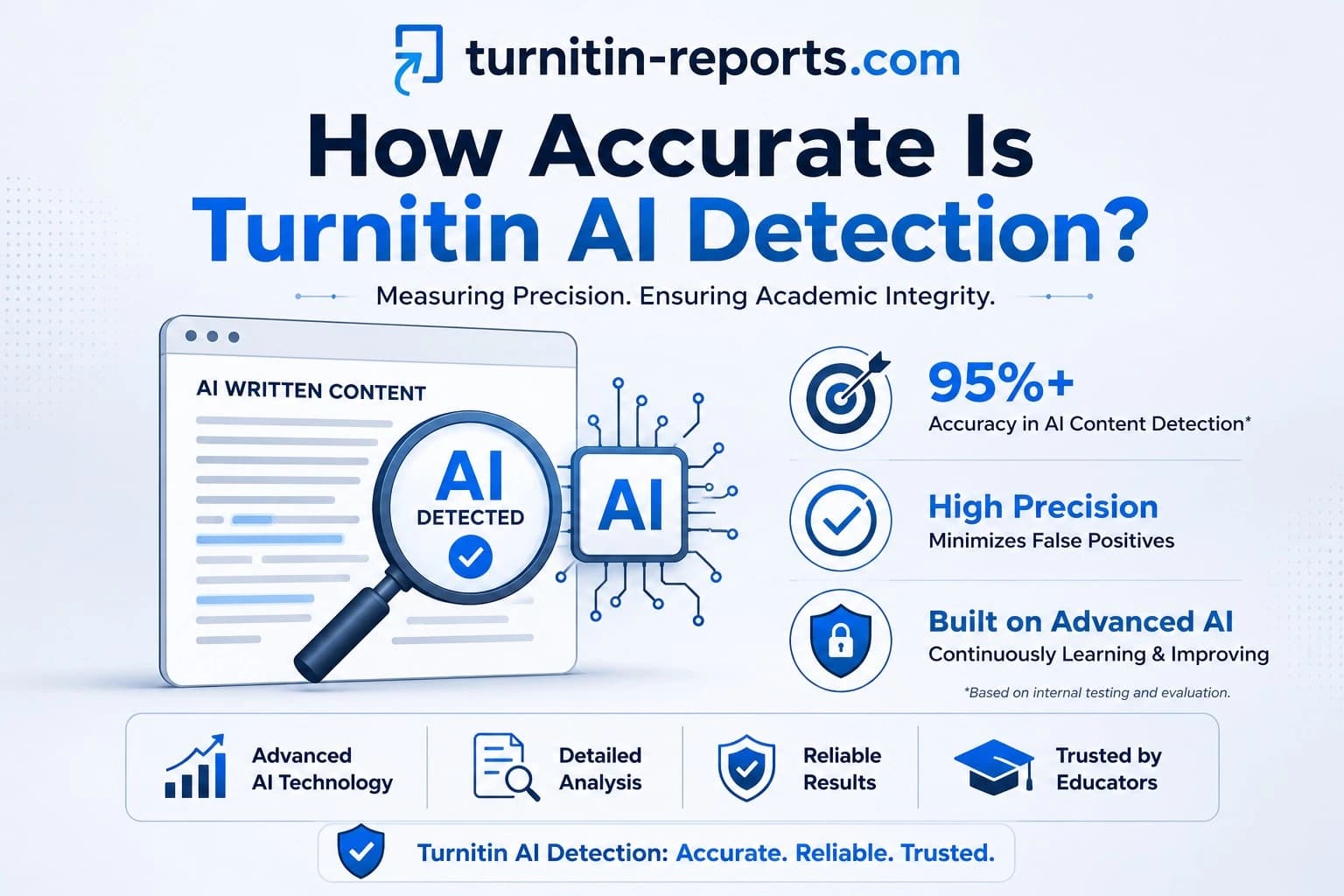
- Turnitin integrates AI detection directly with its institutional submission infrastructure. Because instructors control the report and students submit through a managed platform, Turnitin scores carry formal academic weight in a way standalone tools do not. On raw AI text, independent testing has found Turnitin achieves around 96% detection accuracy. On paraphrased AI text, Turnitin leads the field at approximately 72% recall — meaningfully higher than Copyleaks (68%) and GPTZero, which drops further. However, Turnitin's false positive rate has been measured at around 8% in independent studies, which is higher than GPTZero's 0.24% on the same benchmarks.
- GPTZero was built as a standalone detector and uses a similar perplexity-burstiness framework. On raw AI text it achieves around 92% detection. Its standout characteristic is an extremely low false positive rate — around 0.24% — making it the least likely to wrongly flag human-written work. However, it lags behind Turnitin on paraphrased content.
- Copyleaks claims AI detection across 30+ languages, which is a significant multilingual advantage neither Turnitin nor GPTZero can match. Turnitin's AI detection (including paraphrasing and bypasser detection) is English-only. Copyleaks' accuracy on raw English AI text is around 90%, with a false positive rate of approximately 3–5%.
None of these tools agree perfectly. Our post on how accurate Turnitin's AI detection is covers the false positive problem in detail — including why non-native English speakers face disproportionate risk.
What the detector cannot catch
Turnitin is transparent about its limitations. Turnitin's own FAQ acknowledges that the detector intentionally misses a portion of AI-generated text in order to keep false positive rates low — a deliberate trade-off. Beyond this built-in miss rate, there are structural limits:
- Heavily human-edited AI content. When a human rewrites AI-generated text substantially — changing structure, adding personal voice, reordering arguments — the underlying statistical fingerprint degrades. The BestColleges hybrid test showed that a submission that was 65% AI-generated scored only 48% on Turnitin's detector, suggesting human editing suppresses detection beyond the raw AI percentage.
- Non-English submissions. AI detection, including paraphrasing and bypasser detection, is limited to English. Content in other languages returns no AI score regardless of origin. Our post on Turnitin AI detection language support covers what this means for international students.
- Purpose-built humanizers. Tools specifically designed to defeat AI detectors can reduce AI scores dramatically. Independent testing found that content processed through a purpose-built NLP humanizer returned 0% on every major detector. Turnitin's August 2025 bypasser update was a direct response to this category of tool — but it is an ongoing arms race. Our post on whether Turnitin detects AI humanizers covers the current state of that detection layer.
What this means if you are flagged
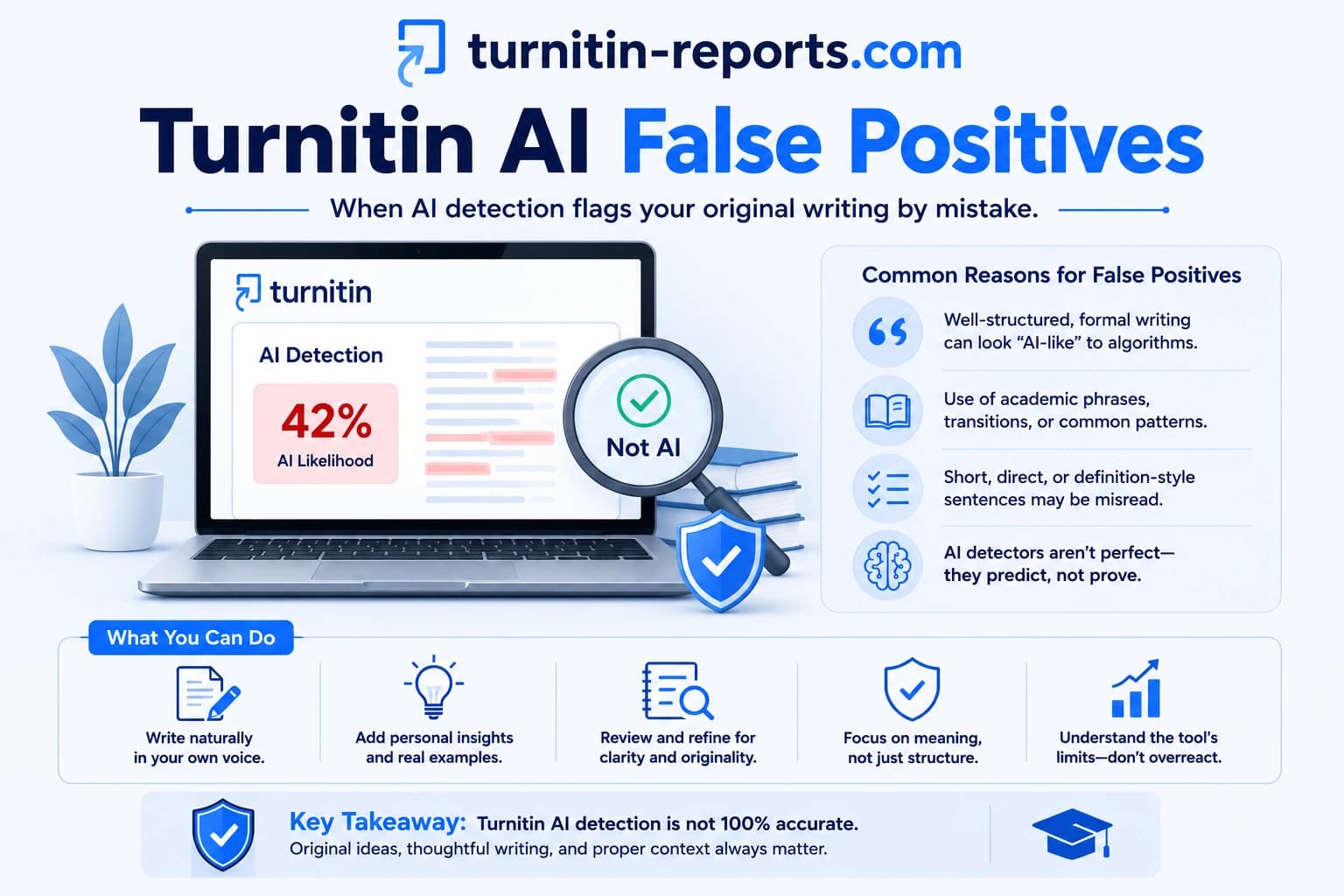
Because the detector works on statistical patterns rather than matching text to a database of known AI output, it can flag human-written work that happens to score low on perplexity — formulaic writing, simplified sentences, or text written in a very structured academic style. This is the root cause of false positives. Turnitin itself states that the AI score should not be used as the sole basis for adverse academic action against a student.
If you are flagged and your work is genuinely your own, our guide on Turnitin AI false positives explains which writing styles are most at risk and what steps to take when contesting a wrongful flag.
Frequently asked questions
Does Turnitin use the same AI detector as GPTZero or Copyleaks?
No. Turnitin's AI detection model is proprietary and built in-house. GPTZero and Copyleaks are separate products with their own models and training data. All three use perplexity and burstiness as core signals, but their training corpora, thresholds, and pipelines differ — which is why they sometimes produce different scores on the same text.
When did Turnitin add the ability to detect paraphrased AI content?
Paraphrasing detection was substantially improved with AIW-2 in December 2023, which trained on examples of AI text that had been run through tools like QuillBot. A dedicated paraphrasing model was added in July 2024. Bypasser detection — targeting tools specifically designed to evade AI detectors — was added in August 2025.
What is perplexity in the context of AI detection?
Perplexity measures how predictable each word choice is given the words that came before it. AI language models generate text by selecting high-probability words — so AI output tends to have low perplexity (very predictable). Human writing tends to have higher perplexity because people make more varied, less statistically probable word choices. Turnitin's detector uses perplexity alongside burstiness (sentence length variation) to distinguish AI from human writing.
Can Turnitin detect AI writing in languages other than English?
No. Turnitin's AI writing detection — including paraphrasing and bypasser detection — is only available for English-language submissions. Submissions in other languages produce no AI score regardless of origin.
Ready to check your paper?
Get your Turnitin report in minutes.
Same report your institution generates — delivered privately, fast.