Turnitin AI False Positives: Why Human Writing Gets Flagged as AI
Turnitin claims a false positive rate of less than 1% — but sentence-level errors, a documented bias against non-native speakers, and real campus misconduct cases tell a more complicated story. Here's what actually causes false positives and what to do if it happens to you.
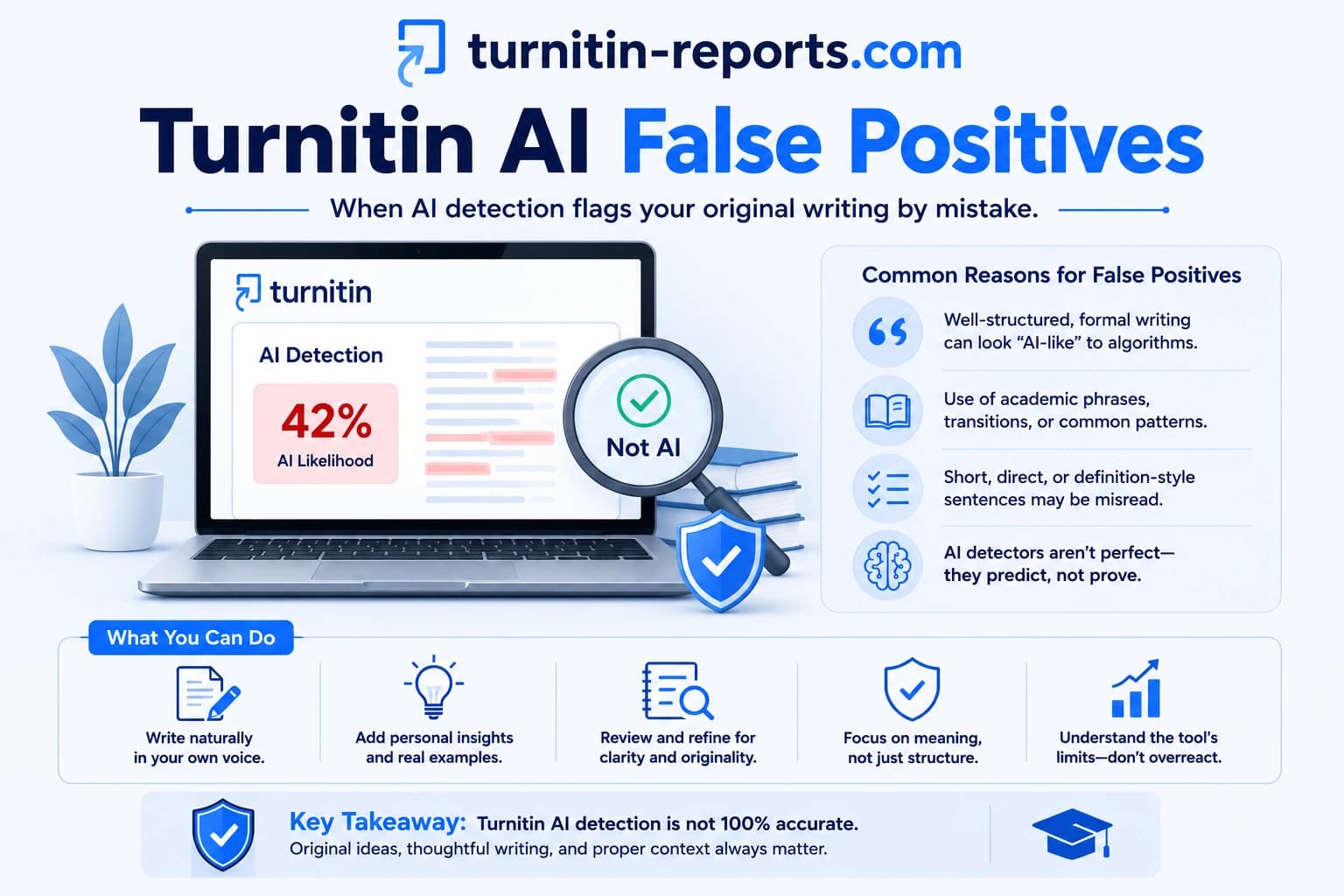
Turnitin's AI detection tool flags a percentage of your paper as AI-written. But what if you wrote every word yourself? This is the false positive problem — and it is far more common, and far more consequential, than most students realise. This guide explains what causes false positives, who is most at risk, and what you can do if you get flagged unfairly.
What is a false positive in Turnitin AI detection?
A false positive occurs when Turnitin's AI detection tool classifies human-written text as AI-generated. The tool assigns a percentage to your paper — say, 35% AI — but that percentage includes sentences you wrote yourself. Turnitin does not tell you which specific sentences it believes are AI-generated in a way that makes the reasoning transparent. It produces a score, and that score can be wrong.
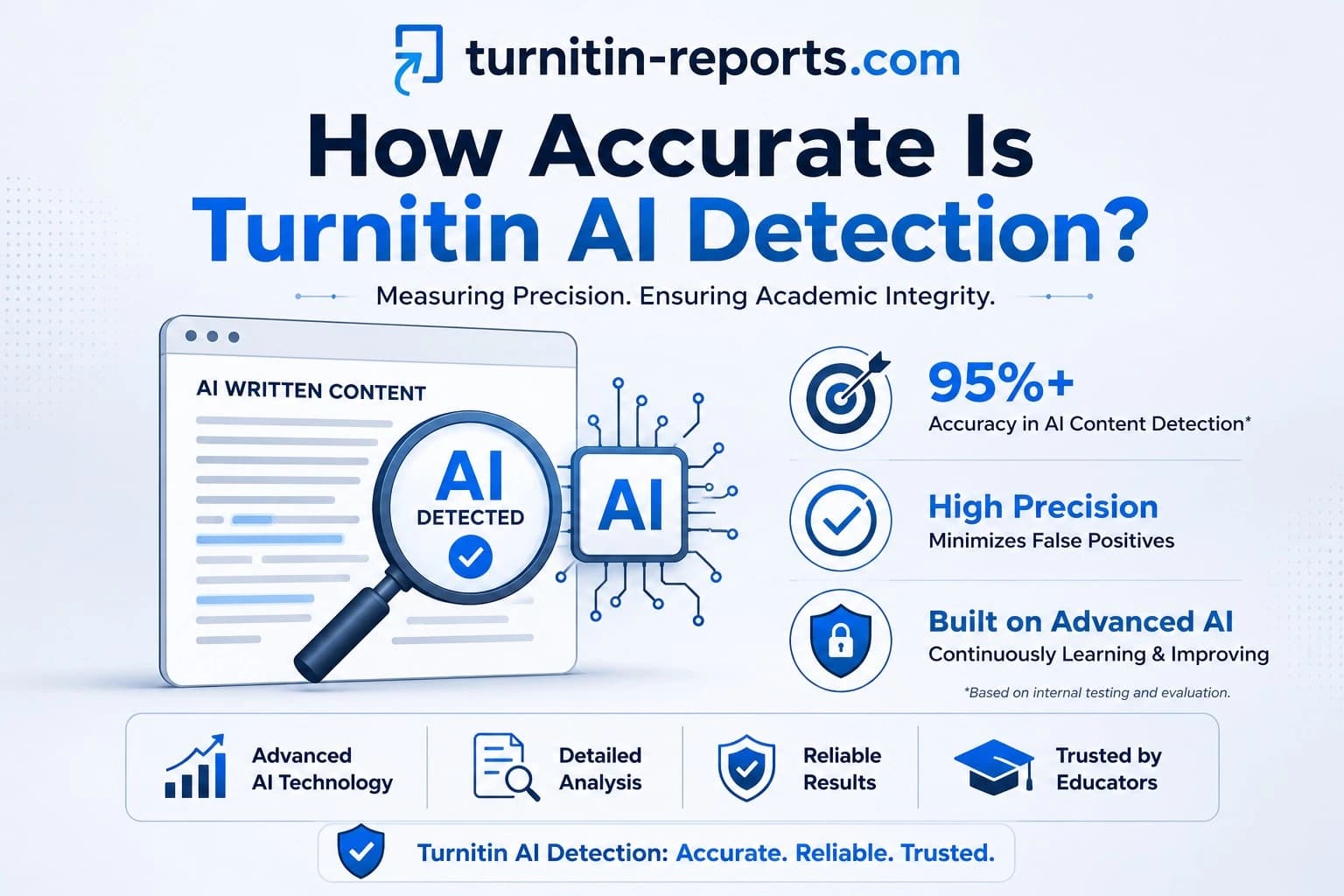
Turnitin acknowledges on its own blog that false positives exist. The company claims a false positive rate of less than 1% at the document level for papers with more than 20% AI content — but also admits a sentence-level false positive rate of around 4%, a miss rate of up to 15% for actual AI text, and accuracy that drops to 60–80% for mixed human-AI content. That sentence-level figure matters: in a 2,000-word essay, a 4% sentence-level error rate can flag several perfectly human paragraphs.
What causes false positives
Turnitin's AI detector works by analysing statistical patterns in text — sentence length consistency, vocabulary range, syntactic predictability. The problem is that these same patterns appear in certain types of legitimate human writing:
- Formal academic writing style. Literature reviews, methodology sections, and five-paragraph essay structures are highly formulaic by design. The clear topic sentences, consistent paragraph structure, and controlled vocabulary that lecturers ask for can closely resemble AI output statistically.
- Simple, controlled vocabulary. Students who write clearly and avoid unnecessary complexity — especially those following plain-English guidance — produce text with lower lexical variety, which AI detectors associate with generated content.
- Heavy editing and proofreading. A heavily revised draft that has had awkward phrasing smoothed out looks more “polished” than a first draft. AI detectors can read that polish as a signal of generation rather than revision.
- Use of grammar tools. Running a paper through Grammarly or similar tools homogenises sentence structure and vocabulary in ways that can nudge a score upward.
- Short or formulaic documents. Cover letters, lab reports, and structured short-answer responses leave little room for stylistic variation, making them statistically closer to AI output.
Non-native English speakers are disproportionately affected
The false positive problem is not evenly distributed. Research from Stanford found that AI detectors falsely flagged 61.3% of essays written by Chinese non-native English speakers, compared to just 5.1% of essays by native US students. The reason is structural: non-native writers often default to simpler, more consistent sentence constructions to avoid grammatical errors. That controlled, careful writing pattern is precisely what AI detectors are trained to find suspicious.
Vanderbilt University cited this bias directly when it disabled Turnitin's AI detector, noting that if even a 1% false positive rate applied across 75,000 annual submissions, roughly 750 innocent students could face misconduct proceedings per year. Washington State University estimated around 1,485 false positives in a single semester under similar assumptions.
This is not a theoretical edge case. In 2024, Australian Catholic University recorded approximately 6,000 alleged AI misconduct cases, the vast majority AI-related, with a significant number later dismissed following investigation. Real students faced real academic consequences — stress, grade penalties, and formal disciplinary processes — for work they had written themselves.
What Turnitin says institutions should do
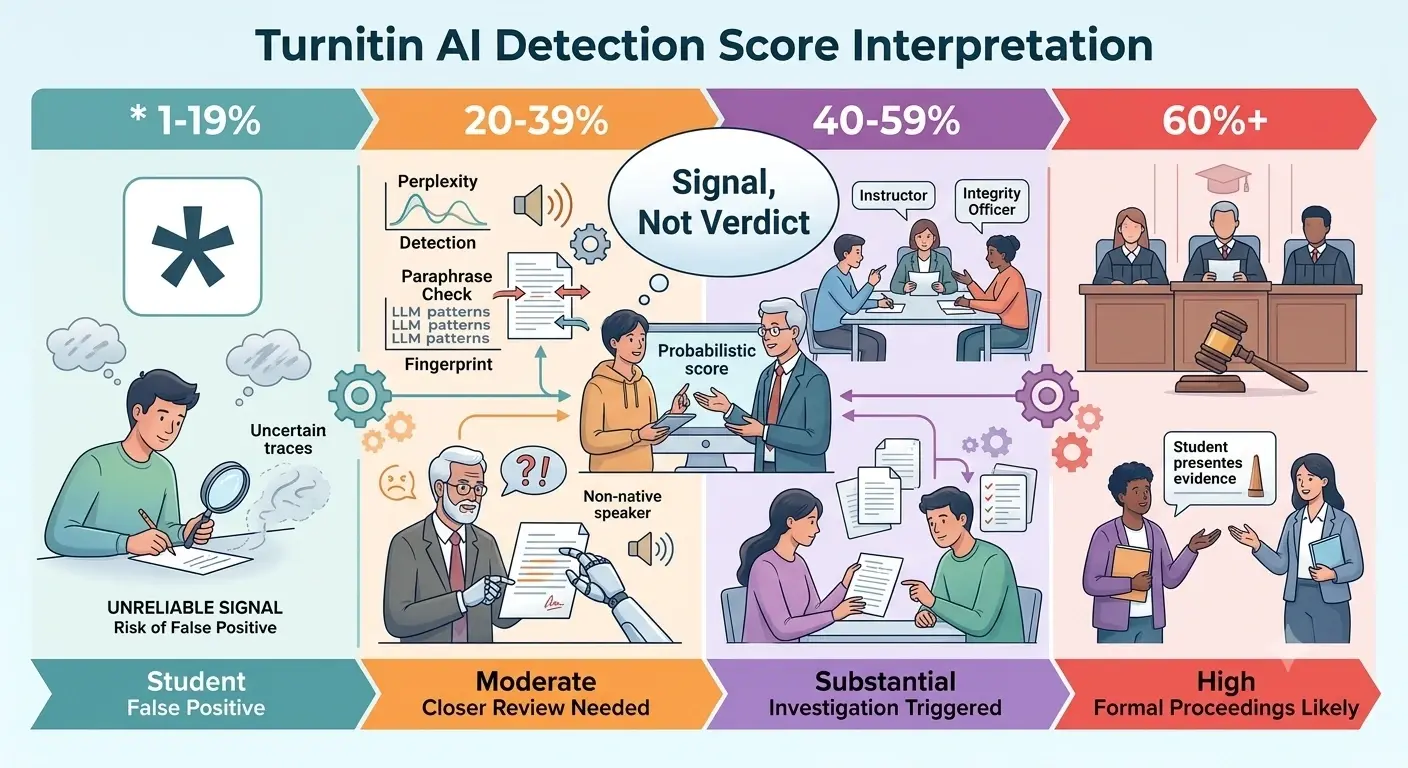
Turnitin's official guidance is consistent on one point: the AI score should never be the sole basis for an academic misconduct finding. Their FAQ states explicitly that the tool is designed to “support educators in identifying potential AI writing” and that instructors must conduct further investigation before taking any action.
In practice, this means a high AI score should prompt a conversation, not an automatic penalty. Many universities have adopted this approach, treating the Turnitin score as a flag for review rather than evidence of wrongdoing.
What to do if you are falsely flagged
If your paper returns a high AI score and you know the work is your own, you have several lines of defence:
- Gather your writing evidence. Google Docs version history, local file timestamps, and draft saves all show the evolution of a document over time. This is difficult to fabricate and is often compelling to an instructor or academic integrity panel.
- Request a conversation. Do not ignore a high score or a misconduct notice. Ask to meet with your instructor and explain your writing process. Instructors can often tell from a conversation whether a student wrote their own work.
- Know your institution's process. Most universities have a formal appeals process for academic misconduct findings. A Turnitin AI score alone is not sufficient evidence to sustain a finding if you can demonstrate your writing process.
- Check your own score before submission. Running your paper through Turnitin yourself before your deadline gives you the opportunity to see your AI score, understand which sections are flagged, and revise if needed — before any misconduct process begins.
Frequently asked questions
Can a 0% AI score guarantee I won't be accused of using AI?
A 0% score is strong evidence in your favour, but Turnitin's tool has a miss rate for actual AI text too. Institutions that suspect AI use may rely on other indicators beyond the score — sudden changes in writing style, inconsistencies with in-class work, or use of AI-specific phrasing. The score is one data point, not a conclusive verdict in either direction.
Does editing AI-written text lower the score?
Sometimes, but not reliably. Turnitin has added detection layers specifically targeting AI content that has been paraphrased or lightly edited. Submitting AI-written work as your own is academic misconduct regardless of the score — and the risk of detection is real.
Are some subjects more likely to produce false positives?
Yes. Subjects with highly structured writing conventions — law, science, medicine, and engineering — tend to produce more false positives because the expected writing style is formal and consistent. Open-ended humanities essays with more stylistic variation tend to score lower.
Is Turnitin's AI detector getting more or less accurate over time?
Turnitin updates its model regularly and claims improvements with each release. However, as AI writing tools also evolve, the detection landscape shifts continuously. Independent research has consistently found accuracy lower than Turnitin's own claims, particularly for non-native speakers and mixed-content documents.
Ready to check your paper?
Get your Turnitin report in minutes.
Same report your institution generates — delivered privately, fast.