How to Have the AI Cheating Conversation with a Student
The Turnitin AI score is a prompt for a conversation, not a verdict — and how you handle the next thirty minutes will shape a student's record, your relationship, and your institution's legal exposure. Here is the instructor-to-instructor protocol: how to open the meeting, what evidence to ask for, how to read the answers, when to escalate, and how to close the loop when you believe the student.
You opened the AI Writing Report at 11pm and a number stared back at you — 78%, or 92%, or the dreaded 100. Now you have to sit across from a student tomorrow morning and figure out what actually happened. This post is written for that moment. It draws on Turnitin's own guidance, the work of academic integrity scholars, and the practical protocols that university teaching centres have converged on over the past three years. The through-line is simple: a detection score is a prompt for a conversation, not a conviction. What you do in the next 24 hours will shape a student's academic record, their trust in you, and — if you get it wrong — potentially your institution's legal exposure.
The score is the start, not the verdict
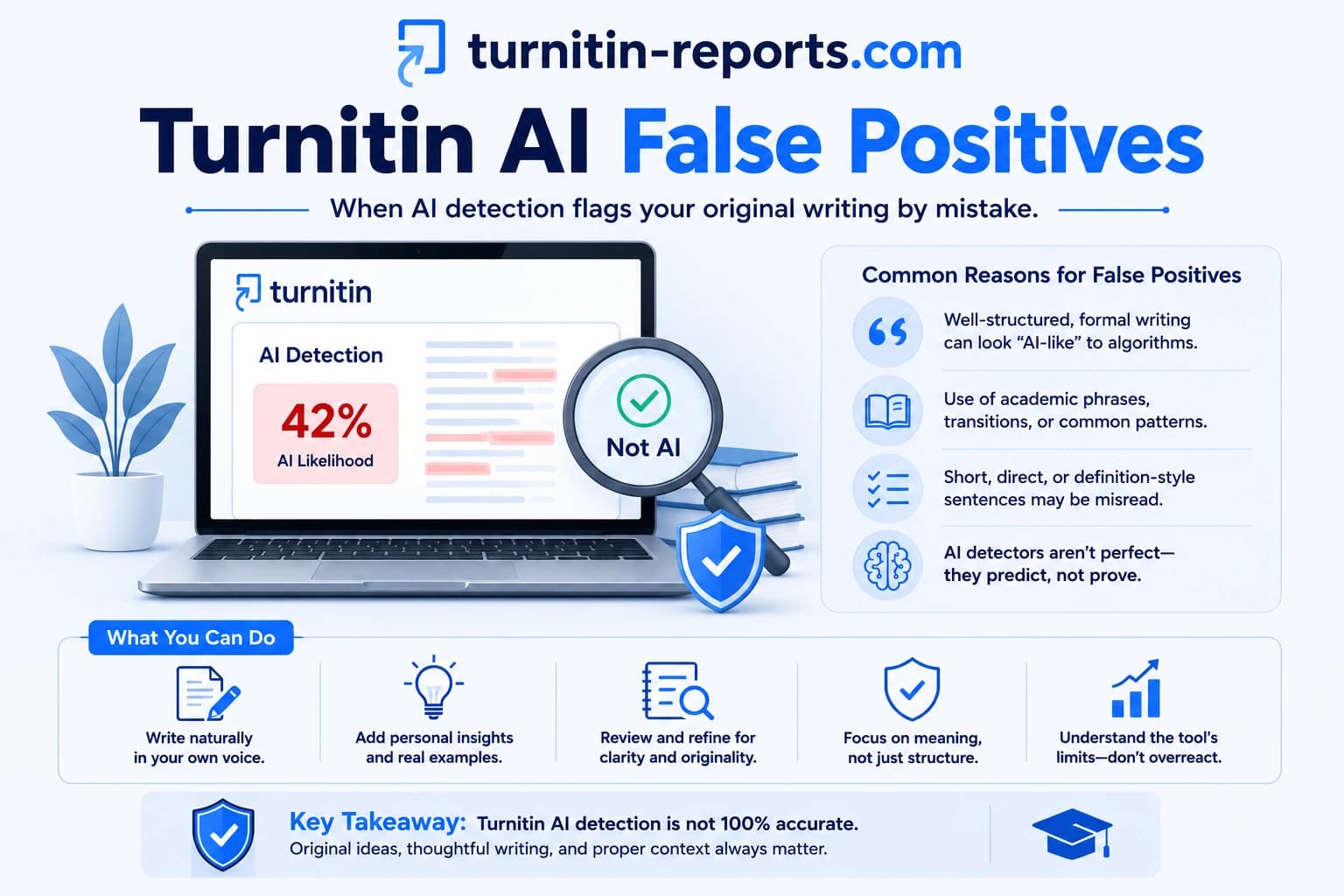
Turnitin's own instructor documentation is unambiguous on this point. The AI indicator, the company writes, is meant to prompt a conversation with the student, not to serve as evidence of misconduct on its own. Its published guidance on false positives and the AI Writing Report both state that the score should not be the sole basis for adverse action against a student. Our own analysis of documented Turnitin AI false positives covers the specific patterns and cases in more depth. That is not a legal disclaimer to protect the vendor — it reflects what the tool can and cannot do. As the underlying detection model works on statistical patterns in text, it can and does flag human writing that happens to be low-perplexity — formal, methodical, or written by non-native English speakers.
Stanford researchers demonstrated the scale of this problem in a 2023 study published in Patterns, in which seven widely used AI detectors flagged writing by non-native English speakers as AI-generated 61.3% of the time, while making almost no such errors on native English speakers. The Markup's reporting on the study is worth reading before your meeting. If the student you are about to speak with is an international student, or writes in the plain, structured register that ESL instruction rewards, the base rate of false positives in your Turnitin report is not what you think it is.
Before the meeting, set yourself up
Do three things before the student walks in. First, read the flagged passages, not the summary percentage. Ask whether the highlighted sentences read differently from the rest of the paper, or whether they look like standard methodology, definitions, or citation-heavy passages that any careful writer would produce. Second, compare the flagged writing to something the student wrote earlier in the semester — a low-stakes discussion post, a draft, a handwritten in-class response. Voice inconsistency is far more diagnostic than any algorithm. Third, decide in advance what outcome you are willing to accept: a restorative conversation, a rewrite, a formal report. Walking in without a range of possible endpoints is what turns a conversation into an interrogation.
How to open the conversation
The invitation matters. The University at Albany's teaching resources suggest a message along the lines of: “I'd like to talk with you about your paper. I want to make sure you feel supported on this kind of assignment. Could you come by office hours this week?” That framing does two things: it signals that you take the assignment seriously enough to discuss it, and it gives the student time to gather their own materials.
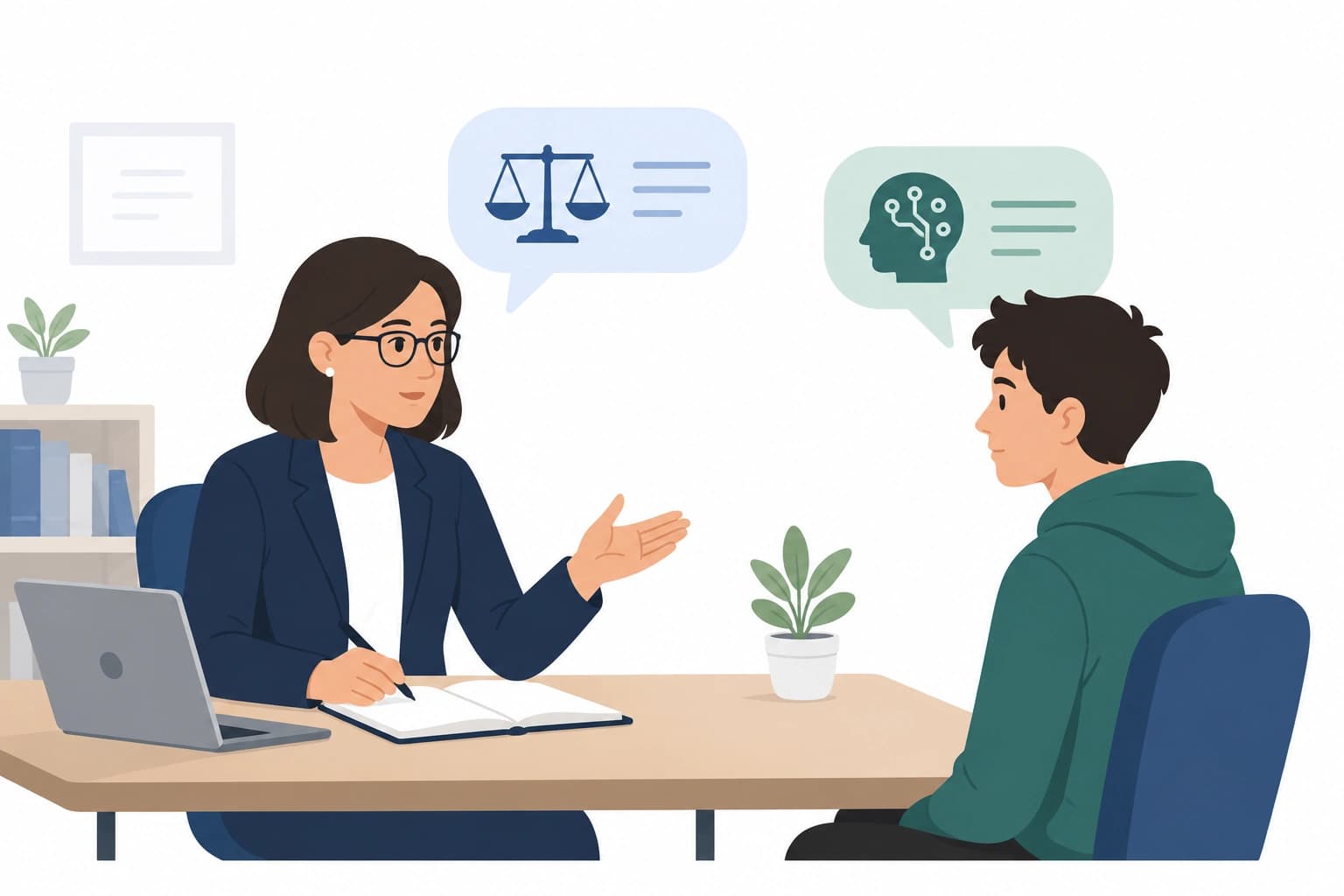
Meet in private, and give the meeting real time — thirty minutes at minimum. Sit at a table, not across a desk. Then open with questions, not statements. Guidance from Tufts' teaching centre and UC San Diego's academic integrity office converges on a few reliable openers:
- “Walk me through how you approached this paper.”
- “What was the hardest part of this assignment for you?”
- “Talk me through the argument in section three — I want to hear it in your own words.”
- “When did you work on this, and what did the process look like?”
Only after the student has described their process do you raise the detection score, and even then with softness: “When I ran the paper through Turnitin, the AI indicator was elevated. I want to understand what might explain that, because I know these tools have false positives.” That sentence — acknowledging fallibility of the tool in front of the student — is what separates a conversation from an accusation.
What evidence to ask for
Before you conclude anything, ask the student to show you their process. Real writing leaves a trail; generated text does not. The most useful artifacts are:
- Version history. In Google Docs, File → Version History shows every autosaved edit with timestamps. In Word, the AutoSave history in OneDrive is equivalent. A document that evolved across a dozen sessions over five days looks nothing like a paste from a chatbot.
- Research notes, outlines, and annotated sources. Highlighted PDFs, margin notes, a bullet-point outline scrawled the night before — anything showing engagement with the source material.
- Ability to discuss the argument. Can the student explain what a specific paragraph is doing? Can they defend a claim, or push back when you challenge it? Students who have written their own paper can nearly always do this. Students who have generated it usually cannot.
- Walk-through of the flagged passages. Point at the specific highlighted sentences. Ask what the student was thinking when they wrote them, what sources they drew on, what earlier draft they came from.
Give the student time to gather these materials. Twenty-four to forty-eight hours is reasonable. A student who is innocent almost always welcomes the chance to prove their process; a student who fabricated the work rarely can, and the gap between the two responses is instructive.
Reading the conversation
Red flags in the meeting are not proof, but patterns are worth noting: inability to explain the argument or define terms used in the paper, insistence that the work “just came together” without a describable process, a version history that shows the entire paper appearing in a single paste event, or a writing voice in the flagged sections that is markedly different from the student's earlier and lower-stakes writing. Conversely, signs of authorship are equally recognisable: a student who can talk fluently about the reading they did, who has a version history with hundreds of edits, who remembers the sentence they cut and can tell you why. If those signals point toward authorship, believe them, regardless of what the score says — and say so out loud before the meeting ends.
If the student admits use
Admissions vary. There is a large gap between “I used ChatGPT to brainstorm and then wrote it myself” and “I pasted the prompt and turned in the output.” Ask the student to describe exactly what they did — which parts they generated, which they edited, whether AI use was permitted by your syllabus at all. Then calibrate. James Lang's Cheating Lessons makes the case that most cheating is situational rather than characterological — driven by workload pressure, unclear expectations, and assessment design that rewards shortcuts. A first offence involving unclear rules is not the same as a repeated, deliberate substitution of a machine for the student's own thinking. Restorative outcomes — a rewrite, a reflective essay, a required tutoring session, a reduced grade rather than a zero — are consistent with what the International Center for Academic Integrity has been moving toward, and with the growing university-level literature on restorative responses to academic misconduct.
If the student denies use and you believe them
Say so, clearly, and close the loop. “Based on what you've shown me, I don't think this is misconduct. I'm marking the paper on its merits.” That sentence is often the most important one an instructor delivers all semester. Then take two follow-up steps. First, document what you saw and decided — the version history, the walk-through, the reasoning — in a short memo to file, in case the flag comes up again. Second, if you feel the detection tool led you astray, consider adjusting how you use it. Turnitin itself now recommends against threshold-based decisions, and a growing number of institutions have disabled or de-emphasised the AI indicator for exactly this reason.
When to escalate
Escalate to your academic integrity office when three things are true: the student cannot produce process evidence after being given a fair chance, the conversation reveals inability to discuss the paper's content or argument, and there is a plausible independent reason to believe generation occurred — voice inconsistency, a paste event in the version history, an admission that unravelled under gentle follow-up. A single elevated Turnitin score by itself does not meet that bar, and increasingly does not meet the legal bar either. In February 2026 a New York state court ordered Adelphi University to expunge a student's record after finding that a 100% AI score used as the basis for a misconduct finding was “without valid basis and devoid of reason.” The precedent is uncomfortable but useful: courts now expect corroborating evidence.
Due process and documentation
If you do refer the case, the student is entitled to written notice of the specific allegation, access to the evidence (including the full AI Writing Report, not just the percentage), a reasonable period to prepare, and an impartial hearing. Your documentation from the initial meeting will be the foundation of that process. Keep it factual: what the score was, what passages were flagged, what the student said when asked to describe their process, what artifacts were requested and produced, what you concluded. Avoid characterisations of intent. If the case reaches the point of a formal appeal, the paper trail you built in the first conversation is what protects both the student and the institution.
The follow-up that matters most
Whatever the outcome, treat the incident as a design signal. Sarah Elaine Eaton's work on the “postplagiarism” era — usefully summarised across her Learning, Teaching and Leadership blog — argues that the presence of AI in student writing is now a permanent feature of the landscape, and that assessment has to evolve in response. Practical follow-ups include process-based assignments that require draft submissions, in-class writing that establishes a voice baseline, oral defences of major papers, and syllabus-level clarity about what AI use is permitted and what is not. An honesty statement at the top of each assignment — brief, specific to that task, signed by the student — is one of the few interventions with consistent empirical support for reducing academic dishonesty.
The conversation you have tomorrow morning will not be pleasant. It rarely is. But if you go in believing the score is a question rather than an answer, ask about process before you speak about suspicion, and let the evidence — not the algorithm — decide what happens next, you will handle it in the way that the field is increasingly converging on. That is better for the student in front of you, and better for the profession the rest of us are trying to keep intact.
Frequently asked questions
Should I confront a student based on a Turnitin AI score alone?
No. Turnitin's own guidance is that the AI Writing indicator is a prompt for conversation, not evidence of misconduct in itself. A single detection score, without corroborating process evidence — voice inconsistency, an inability to explain the paper's content, a version history that shows a paste event — is not a sufficient basis for a misconduct finding, and increasingly courts and integrity offices agree.
What is the best way to open the conversation with a student?
Meet privately, allow at least thirty minutes, and open with questions about the student's writing process rather than statements about your suspicion. Ask them to walk you through their approach, describe what was hardest, and explain the argument in their own words. Only after that discussion should you mention the elevated AI score, and acknowledge openly that these tools produce false positives — that framing preserves the relationship and gives the student space to respond.
What evidence should I ask the student to provide?
Version history from Google Docs or Word (which timestamps every edit), research notes or annotated sources, and a verbal walk-through of the flagged passages. A student who wrote the paper themselves can nearly always produce this evidence and speak fluently about their own argument. Give them 24 to 48 hours to gather materials — a fair window separates innocent students from generated submissions more reliably than any detector.
When should I escalate to the academic integrity office?
Escalate when the student cannot produce process evidence after a fair opportunity, cannot discuss the paper's content or argument, and there is independent corroborating evidence beyond the Turnitin score — voice inconsistency with earlier work, a paste event in the version history, or an admission that emerged during the conversation. A single AI score without those additional signals does not meet the threshold for a formal misconduct case at most institutions and is increasingly vulnerable on appeal.
How do I handle the conversation if the student admits partial AI use?
Calibrate the response to what was actually done and whether your syllabus permitted it. Brainstorming assistance is different from generating final text; using an AI editor is different from pasting an output. Restorative outcomes — a rewrite, a reflective essay on the incident, a required meeting with a writing tutor, a reduced grade — are consistent with current best practice from the International Center for Academic Integrity and are often more educationally effective than a punitive zero for a first offence involving unclear rules.
Ready to check your paper?
Get your Turnitin report in minutes.
Same report your institution generates — delivered privately, fast.
Related articles