What Happens When an International Student Fails a Turnitin Check? Visa and Immigration Consequences
For international students, a Turnitin failure travels beyond the university disciplinary panel — into SEVIS terminations, CAS withdrawals, subclass 500 cancellations, and study-permit compliance flags. With non-native English speakers facing a documented 61.3% false-positive rate on AI detectors, here's exactly what happens after a finding in the US, UK, Australia, and Canada.
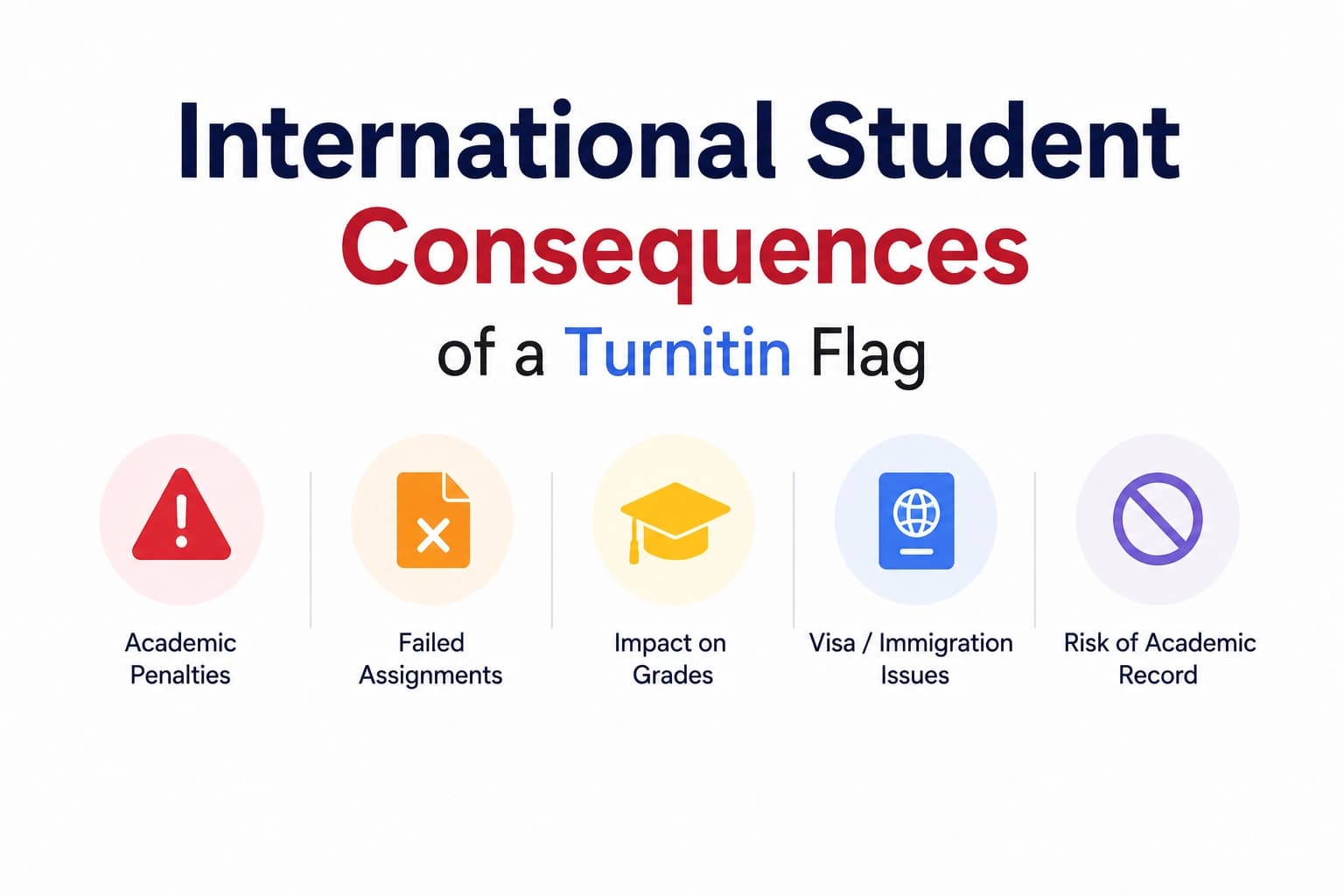
For international students, a Turnitin failure is not the same event that it is for a domestic student. A finding of academic misconduct — whether from the similarity score or the AI Writing Report — does not stop at the university disciplinary panel. It can travel into the immigration system: a terminated SEVIS record in the United States, a curtailed CAS in the United Kingdom, a cancelled subclass 500 visa in Australia, a study-permit compliance flag in Canada. The academic consequence and the immigration consequence are legally separate but tightly linked, and understanding both is what determines whether a false positive becomes a temporary inconvenience or the end of a degree in another country.
This post covers what actually happens after a Turnitin failure for students on an F-1, UK Student Visa, Australian subclass 500, or Canadian study permit — what universities are required to report, what the appeal window looks like, and why the false positive rate for non-native English speakers makes this problem structurally worse for the students who can least afford it.
Why international students face higher false positive rates
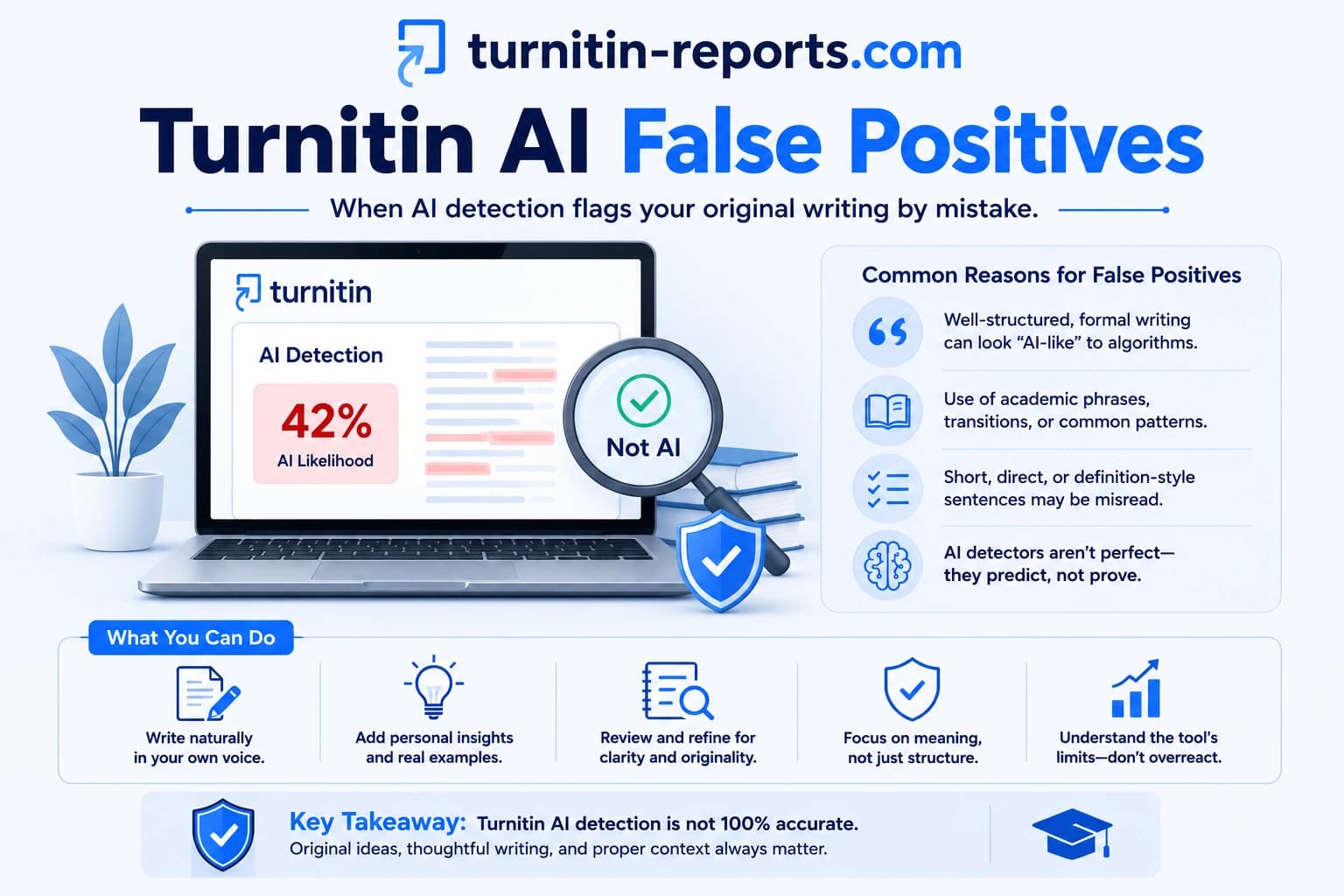
The single most-cited piece of research on this problem is the Stanford study by Weixin Liang and colleagues, published in Cell Patterns in 2023. The researchers tested seven widely used GPT detectors on 91 TOEFL essays written by non-native English speakers and 88 essays by US eighth-graders. The detectors classified the eighth-grader essays correctly. They flagged 61.3% of the TOEFL essays as AI-generated on average — and at least one detector flagged 97.8% of the non-native essays as AI-generated. According to the paper published in Cell Patterns, the underlying reason is technical: detectors rely heavily on text “perplexity” — a measure of how predictable a passage is to a language model — and second-language writers tend to use more predictable vocabulary and simpler sentence structures. Those same features are what modern AI text generation produces. The detector cannot tell them apart.
The Markup's 2023 investigation into AI detection and international students traced the human consequences of this: Turnitin's tool was “much more likely to flag international students' writing as AI-generated,” and the reporting documented multiple cases at US universities where non-native English speakers were wrongly accused. Our post on Turnitin AI false positives covers the mechanism in more detail, and Turnitin's language support explains why the model performs unevenly on non-English source languages.
The scale matters. Universities with 30% or more international enrolment — including NYU, USC, Carnegie Mellon, and Northeastern in the US, and Manchester, UCL, and Sydney overseas — see the false-positive burden fall disproportionately on visa-holding students. When Vanderbilt calculated the projected volume of misclassified papers under Turnitin's own claimed false-positive rate, the number reached the hundreds per semester — one of the reasons Vanderbilt was among the first universities to disable the tool.
F-1 visa (US) — what happens after a misconduct finding
F-1 status is contingent on being a full-time enrolled student at a SEVP-certified institution. A Turnitin finding does not directly involve USCIS or ICE — but the academic sanction that follows can. If your university suspends or expels you for academic misconduct, the Designated School Official (DSO) is required to update your SEVIS record to reflect that you are no longer maintaining status.
According to guidance from Wake Forest's Center for Immigration Services and Support, once SEVIS is updated with a suspension or expulsion, your F-1 status is terminated in the system. You are then expected to depart the United States, usually within a short grace period. There is no automatic grace period equivalent to the standard 60 days that applies after normal program completion — a termination for a status violation typically comes with a 15-day window at most, and in some cases none at all.
Two features of this process are worth understanding clearly:
- The DSO acts on the institutional decision, not the Turnitin score. Turnitin does not communicate with USCIS or SEVIS. The trigger for immigration consequences is the university's disciplinary finding — the suspension or expulsion — not the AI Writing Report itself. This means an appeal that overturns the misconduct finding, before the DSO updates SEVIS, prevents the immigration cascade entirely.
- Reinstatement is possible but not guaranteed. If the disciplinary decision is reversed after termination, students can apply for reinstatement of F-1 status by filing Form I-539 with USCIS. USCIS guidance on Form I-539 confirms this pathway, but approval is discretionary and requires demonstrating that the violation was beyond your control.
The additional layer for F-1 holders is future immigration consequences. A finding of academic dishonesty on your record can be raised in future visa applications, in applications for Optional Practical Training extensions, and in adjustment-of-status applications — because USCIS asks about it. There is no criminal-record equivalent, but a documented dishonesty finding is a factor an adjudicator can weigh.
UK Student Visa — CAS withdrawal and the 60-day curtailment
UK universities are visa sponsors. When a sponsored student is withdrawn for academic misconduct, the sponsor is required to report the withdrawal to UK Visas and Immigration within 10 working days. Once UKVI receives the report, the Student Visa is normally curtailed to 60 days from the date of the curtailment notice — that is the window in which you must either enrol with another sponsor (using a new Confirmation of Acceptance for Studies) or leave the UK.
The Home Office's Student Sponsor Guidance sets out the reporting duty in detail. Sponsors have no discretion to hide a misconduct withdrawal — the sponsor licence itself depends on compliance. What sponsors can do is delay reporting where a student's internal appeal is in progress, and many universities do this in practice to protect the student's ability to remain enrolled if the appeal succeeds.
The second consequence is the “suitability” problem. A dishonesty finding on a UK academic record can engage the general grounds for refusal in the Immigration Rules. Future Student Visa applications, Graduate Route applications, and Skilled Worker applications all require disclosure of prior findings of dishonesty, and the Home Office can refuse an application on suitability grounds. According to Part 9 of the Immigration Rules, dishonesty in a previous application or in academic work is one of the discretionary refusal grounds.
There is also the Office of the Independent Adjudicator for Higher Education (OIA) route. The OIA handles complaints against UK universities after internal processes are exhausted. It has issued case summaries specifically covering AI-related misconduct findings — including cases where students on visas successfully argued that detector reliability for non-native English speakers meant the university's decision was procedurally unfair. The OIA cannot restore a visa directly, but a favourable OIA finding often triggers a university to reinstate sponsorship, which UKVI can then act on.
Australia subclass 500 — Condition 8202 and the three-year exclusion
The Australian subclass 500 visa carries Condition 8202: the visa holder must be enrolled with a registered education provider and must attend courses. Expulsion for academic misconduct breaches Condition 8202 automatically — you are no longer enrolled. Under Regulation 2.43 of the Migration Regulations 1994, breach of Condition 8202 is a ground for visa cancellation.
The Tertiary Education Quality and Standards Agency (TEQSA) has published specific guidance on how academic misconduct affects international students. Providers are obliged to report the outcome of a misconduct finding to the Department of Home Affairs. The most serious consequence is not the immediate cancellation — it is the three-year exclusion period that applies if the visa is cancelled under Regulation 2.43(2)(b). During those three years, you cannot be granted most Australian visas, including further student visas, tourist visas, or skilled migration visas.
The three-year bar is what distinguishes Australia from most other jurisdictions. In the UK or US, a misconduct finding creates disclosure obligations and adjudicator discretion; in Australia, it creates a statutory exclusion. This makes the appeal window — usually 20 working days from the notice — the single most important stage in the process. The Migration and Refugee Division of the Administrative Appeals Tribunal can review a cancellation decision, and there is also the option of applying for merits review before departure.
Canada study permit — DLI compliance reporting
Canada introduced mandatory DLI compliance reporting on 8 November 2024. Every Designated Learning Institution must report the enrolment status of every international student to Immigration, Refugees and Citizenship Canada (IRCC) twice a year, in March and November. According to the IRCC compliance reporting programme, a suspension or expulsion is reported as a change in enrolment status, and IRCC uses the report to assess whether the study permit holder is meeting the “actively pursuing studies” condition of the permit.
A study permit does not lapse automatically on suspension. What happens is that the student's file is flagged as non-compliant, and IRCC can then initiate an investigation. The consequences depend on the case: if the student re-enrols at another DLI within the 150-day leave-from-studies allowance, compliance can usually be restored. If not, IRCC can issue a removal order.
The Canadian system is comparatively more forgiving than the Australian or UK equivalents in that the initial finding does not automatically cancel the permit — but the enrolment gap it creates can, and the flag on the student's IRCC record can influence future permit applications and permanent residence eligibility under the Canadian Experience Class.
What universities are required to report — and what they choose to
The distinction matters. UK sponsors have a licence-condition obligation to report misconduct withdrawals — they cannot lawfully withhold them. Australian providers have a comparable statutory reporting duty to Home Affairs. US institutions have a SEVIS record-maintenance duty but no direct obligation to report academic misconduct as such — the reporting trigger is the change in enrolment status (suspension, expulsion). Canadian DLIs report through the biannual compliance cycle rather than event-by-event.
The practical implication: in the UK and Australia, the sponsor cannot “quietly” resolve a misconduct case without immigration consequences unless the internal decision is fully reversed before the report is filed. In the US, the same is functionally true because SEVIS reflects enrolment status. In Canada, the reporting is periodic, which sometimes creates a window to remediate before a compliance flag is issued.
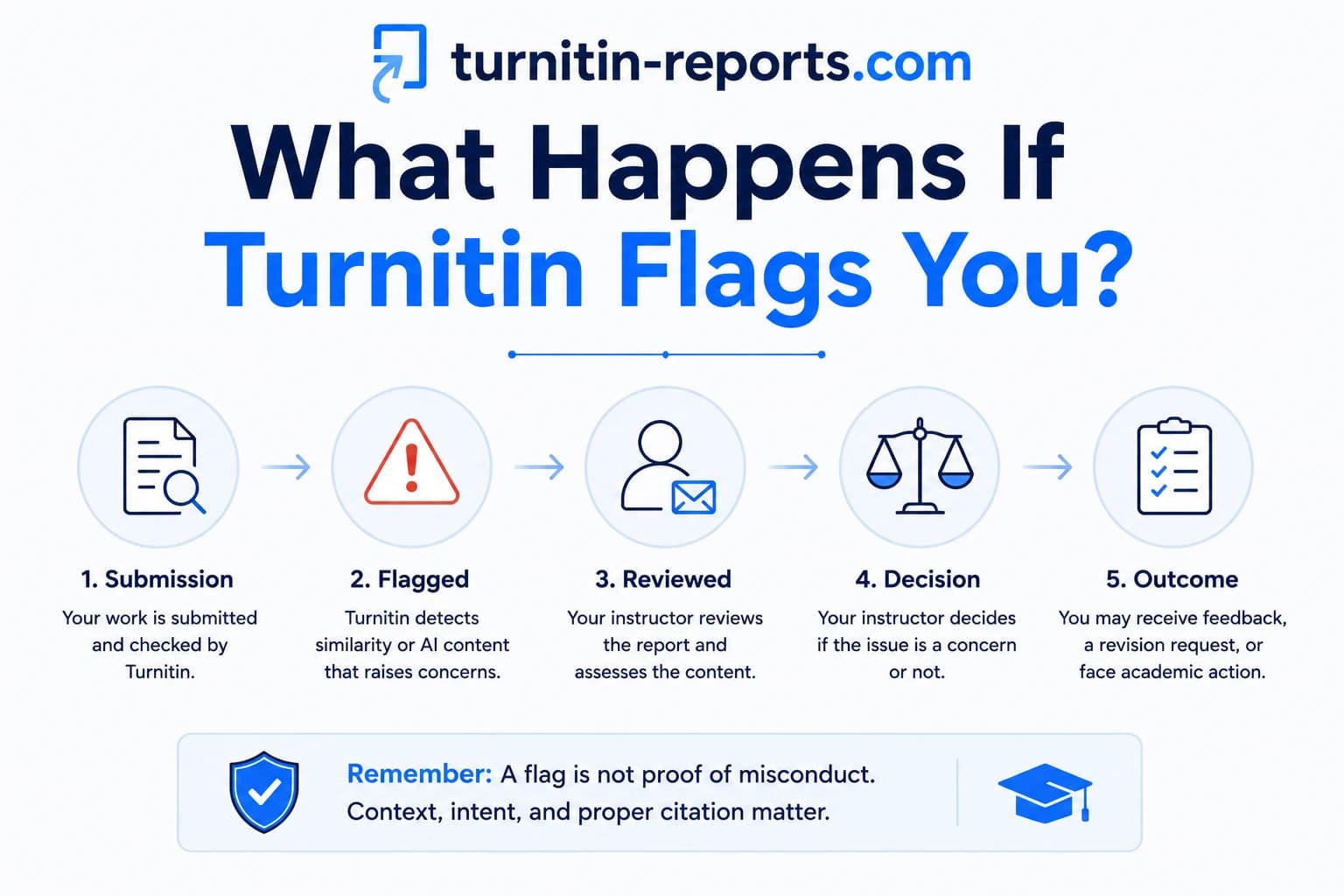
This is one reason our post on what happens when Turnitin flags you emphasises acting immediately: for a domestic student, delay is annoying; for an international student, delay is what turns a false positive into a visa problem. Similarly, the post on whether a professor can report you for a Turnitin AI score is essential reading because the reporting decision — instructor to academic integrity office — is what starts the timer on everything downstream.
Appeals — what is different for international students
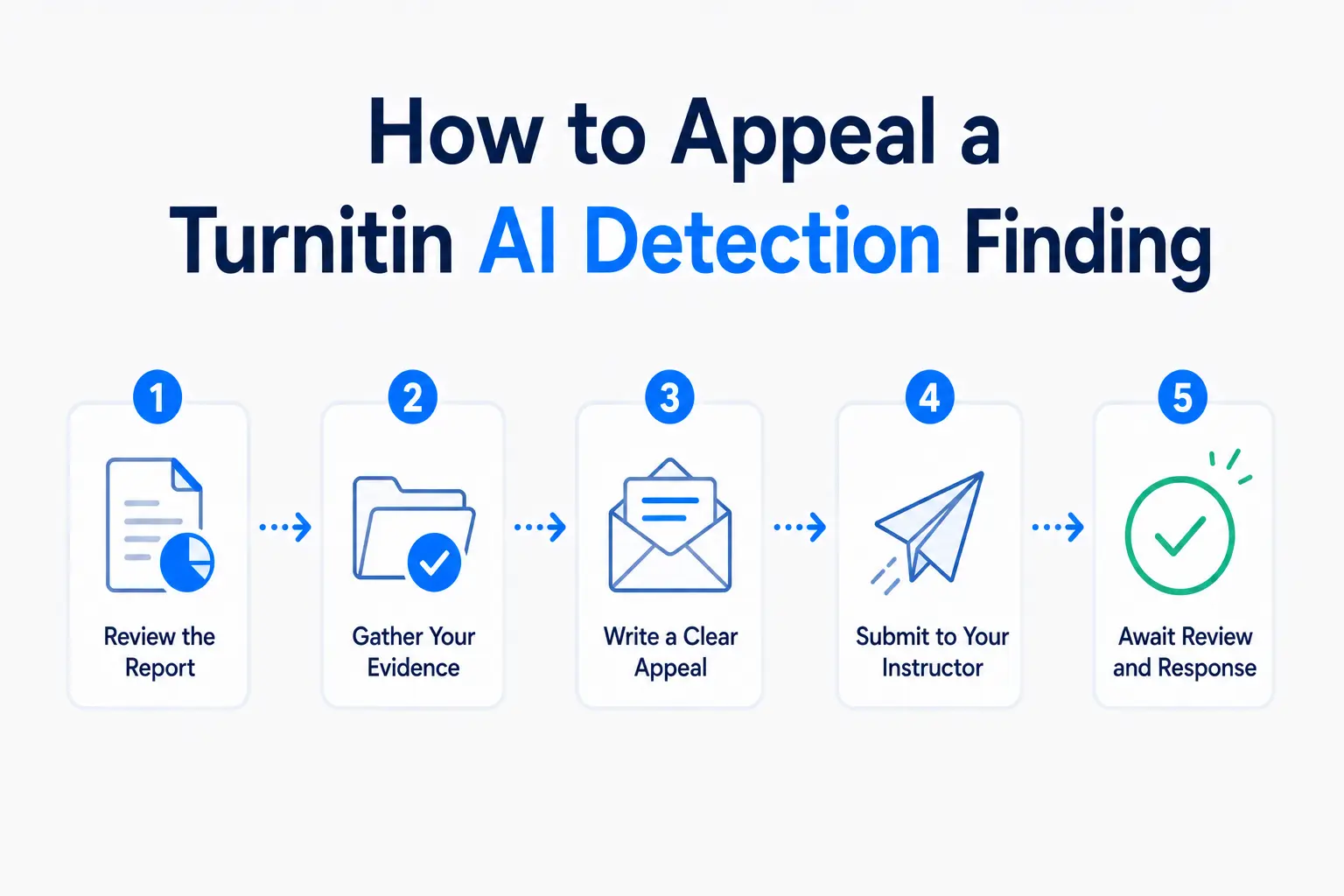
The mechanical appeal process is the same for domestic and international students: submit evidence, present at the panel, use independent detector results and version history as documentation. The full playbook is in our post on how to appeal a Turnitin AI detection finding. What is different for visa-holding students is the pace and the escalation ladder.
- Contact your international student office before, not after, contacting your instructor. The international student adviser can tell you the specific reporting timeline for your jurisdiction and can sometimes ask the institution to hold reporting until an internal appeal concludes. This is a request most institutions honour when made through the international office rather than by the student directly.
- Cite the Stanford research in your appeal. Non-native English speakers have a specific evidentiary argument available to them: the documented 61.3% false-positive rate for their writing profile. This is not an appeal to sympathy — it is a technical challenge to the reliability of the tool for the specific student in question. Combined with independent detector results, this frames the false positive as a foreseeable failure of the tool rather than a defence of a suspected offence.
- Preserve version history immediately. Google Docs, Word, and Overleaf all keep revision histories that show a document being drafted over time. This is the single strongest piece of exculpatory evidence available, and it is more valuable for international students because it addresses the specific weakness of the AI detector — it demonstrates a human drafting process rather than a single-event output. Our post on what to do when Turnitin flagged your work as AI but you wrote it covers the version-history evidence in detail.
- Understand your institution's reporting delay policy. Some UK sponsors will delay reporting to UKVI for up to the 10-working-day statutory limit while an internal appeal is initiated; some Australian providers will pause reporting to Home Affairs pending appeal. This is not universal and is usually not documented publicly — the international student office knows the local practice.
Documented cases — international students who won
Times Higher Education reported in 2024 on multiple UK appeals in which international students overturned AI-detection findings, in part by citing detector reliability for non-native English writing. The Office of the Independent Adjudicator has published case summaries including cases where the OIA upheld student complaints on procedural grounds tied to detector unreliability.
In the US, the Thierry Rignol case at Yale School of Management, the Orion Newby ruling against Adelphi University (February 2026), and the ongoing University of Minnesota litigation over the Haishan Yang expulsion — a Chinese national PhD student whose expulsion cost him his legal right to remain in the US — have collectively established that a Turnitin or GPTZero score alone is not a lawful basis for a misconduct finding. Our post on how Turnitin's AI detection works explains the specific technical limitations that appeals repeatedly succeed on.
The pattern in successful appeals is consistent: layered evidence (version history plus independent detector results plus a technical argument about detector reliability for the student's writing profile), a formal escalation through the international student office, and a clear timeline that begins within days of the finding rather than weeks. What loses appeals is silence, delay, and reliance on the plain assertion that the student did not use AI.
Practical evidence checklist for international students
- Preserve everything immediately. Do not delete drafts, browser history, emails, or notes. Export version history from Google Docs (File → Version History → See version history → Download) or from Word's AutoSave. Take screenshots with visible timestamps.
- Run the flagged text through two or three independent AI detectors. GPTZero, Copyleaks, and Originality.ai each produce different verdicts; a divergence across tools is itself evidence that the score is not reliable. Save the full result pages, not just the headline number.
- Prepare the Stanford citation. Include a printed copy of the Cell Patterns paper and the summary of Turnitin's own published statement that the AI score should not be sole evidence of misconduct.
- Contact the international student office within 48 hours of receiving the notice. Ask specifically about the sponsor's reporting timeline and whether reporting will be delayed pending appeal.
- Document your writing process. Research notes, annotated PDFs, outlines, and correspondence with your supervisor all evidence a human drafting process that AI output does not produce.
- Get advice from an immigration lawyer, not only the university adviser. The university adviser knows the internal process; an immigration lawyer knows the interaction with the visa. Many jurisdictions have student unions or ombuds services that can refer you to free or reduced-fee immigration advice.
The underlying problem
The structural issue is that a single tool with a documented bias against non-native English writing is being used to trigger a chain of consequences that runs from the university disciplinary panel through to the immigration system, in jurisdictions where visa status depends on continuous enrolment. Detector reliability is a matter of statistical accuracy; visa status is a matter of legal presence. Linking the two through automated reporting pipelines means that a false positive rate that would be a nuisance in a domestic academic context becomes an existential problem for a student in a foreign country.
Universities are beginning to respond — Vanderbilt, Michigan State, Yale, UC Berkeley, and the University of Waterloo have all disabled or restricted Turnitin's AI detection specifically on false-positive grounds. Institutional policy is moving in the direction of treating the AI score as one signal among many rather than as evidence in its own right. Until that becomes universal, international students bear a disproportionate share of the risk that the tool creates — and the appeals process, promptly and correctly engaged, is what stands between a false positive and a curtailed visa.
Frequently asked questions
Can a Turnitin AI detection finding directly cancel my visa?
No — Turnitin has no direct relationship with USCIS, UKVI, the Australian Department of Home Affairs, or IRCC. The immigration consequence is triggered by the university's disciplinary sanction (suspension or expulsion), not by the AI Writing Report. This is why an appeal that overturns the internal finding, before the university updates its reporting to the immigration authority, prevents the visa consequence entirely. The academic decision and the immigration decision are legally separate but sequentially linked.
How long do I have to appeal before immigration consequences kick in?
It depends on the jurisdiction. In the UK, sponsors must report to UKVI within 10 working days of a withdrawal decision, and once UKVI acts, the visa is normally curtailed to 60 days. In the US, DSOs update SEVIS on the basis of enrolment status changes, and the grace period after termination can be as short as 15 days. In Australia, appeal windows are typically 20 working days. In Canada, DLI reporting is biannual, so the timing is less immediate. In every case, contacting the international student office within 48 hours of receiving the notice is critical to preserving your options.
Does the Stanford 61.3% false-positive study apply to Turnitin specifically?
The Stanford study tested seven GPT detectors, not Turnitin specifically — but the underlying mechanism it identifies (detectors classifying low-perplexity writing as AI-generated) is the same mechanism Turnitin's AI Writing Report uses. Independent testing and reporting, including by The Markup and multiple universities that have subsequently disabled Turnitin, have consistently found the same pattern applies to Turnitin. The finding is technical rather than product-specific: any detector that relies on perplexity will misclassify non-native English writing at elevated rates.
If I win my appeal, will the finding still appear on my record?
A successful appeal that overturns the finding typically results in the misconduct record being expunged from the academic transcript. This was the specific remedy ordered by the court in the Orion Newby case against Adelphi University. However, the underlying investigation record often remains in internal university files even after the finding is reversed. For future visa applications, the answerable question is usually whether you have a “finding” against you — a reversed finding is answered as no. If you are asked about investigations more broadly, seek legal advice on the exact wording of the disclosure question in the visa application concerned.
Ready to check your paper?
Get your Turnitin report in minutes.
Same report your institution generates — delivered privately, fast.
Related articles