Should Instructors Rely on Turnitin's AI Detection? What the Research Actually Says
Turnitin's own guidance says its AI score should not be the sole basis for adverse action against a student — and independent research, a growing list of universities disabling the tool, and the Newby v. Adelphi court ruling all point the same way. Here is what the evidence supports, when the score is worth taking seriously, and what defensible instructor practice looks like instead of relying on the number.
Turnitin's AI writing indicator is now the single most consequential number in most academic-integrity offices. It arrives with a headline percentage, a colour, and the quiet authority of a machine that has apparently read the paper. It is also, on the evidence of Turnitin's own guidance, three years of independent testing, at least one court judgment, and a growing list of institutions that have simply switched it off, a number that does not deserve to carry that much weight.
This piece is written for colleagues who take both academic integrity and due process seriously. It is not an argument that generative AI is harmless, or that students should be trusted uncritically. It is an argument about what the score can and cannot tell you, and what a defensible investigation looks like when the machine says a paper is AI-written.
What Turnitin actually tells instructors
The starting point is worth stating plainly, because it is routinely forgotten in disciplinary meetings. Turnitin's official product guidance instructs educators that the AI writing indicator “may not always be accurate” and “should not be used as the sole basis for adverse actions against a student.” The company's Chief Product Officer, Annie Chechitelli, has been publicly candid that the tool is calibrated to miss roughly 15% of AI writing in order to keep the document-level false-positive rate below 1%, and that a sentence-level false-positive rate of around 4% is baked into the design.
This is not marketing hedge language. It is a structured instruction that the number is a signal, not a verdict. Any institutional workflow that treats the percentage as prima facie evidence of misconduct is using the tool against the vendor's own written guidance.
What the independent research actually shows
On raw, unedited output from a mainstream large language model, longer than about 300 words, in native English, Turnitin performs reasonably well. Independent testing typically puts detection rates in the 90–96% range, with F1 scores against unedited AI output around 0.92 — ahead of most competitors and broadly consistent with Turnitin's own claims for that narrow condition.
The condition matters. As soon as any of the assumptions break, performance drops sharply. A peer-reviewed study in the International Journal for Educational Integrity found that AI detectors, including Turnitin, saw accuracy fall to the 40–70% range once AI text was manually edited or paraphrased. A Nature news feature on AI detector limitations summarised the same problem: current detectors are not robust to the workflows students actually use.
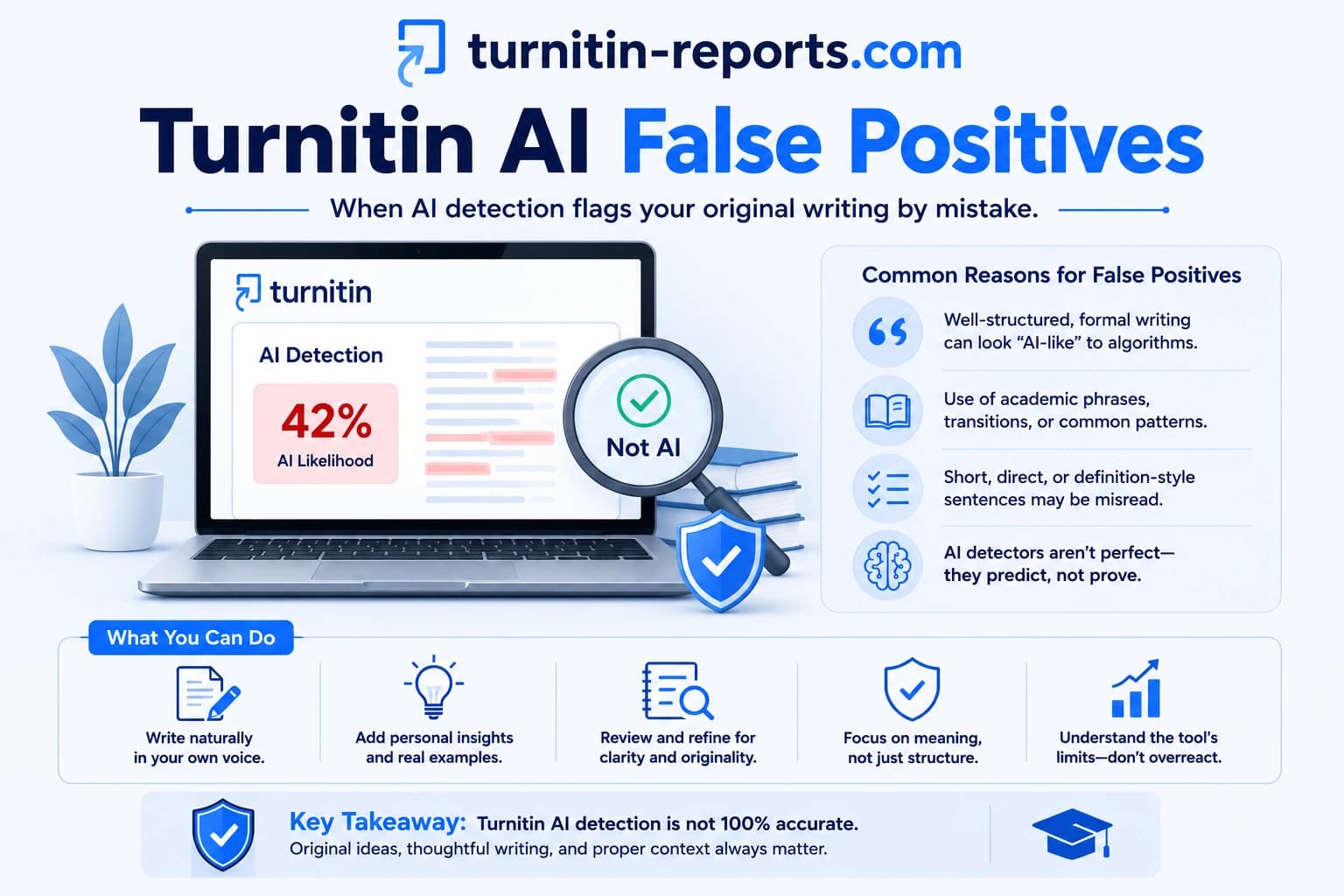
The most-cited piece of evidence is the Stanford HAI study by Liang and colleagues, which found that seven leading AI detectors falsely classified 61.3% of TOEFL essays written by non-native English speakers as AI-generated, while flagging near zero percent of native-speaker essays under the same conditions. Turnitin disputes the specifics of the methodology, but the underlying mechanism — perplexity- and burstiness-based detection systematically misreads writing that is grammatically careful, formulaic, and lexically restrained — is not seriously in dispute in the linguistics literature.
We have written the full breakdown of these figures elsewhere: how accurate Turnitin AI detection actually is, and what causes false positives.
The three-model pipeline — and what it has not fixed
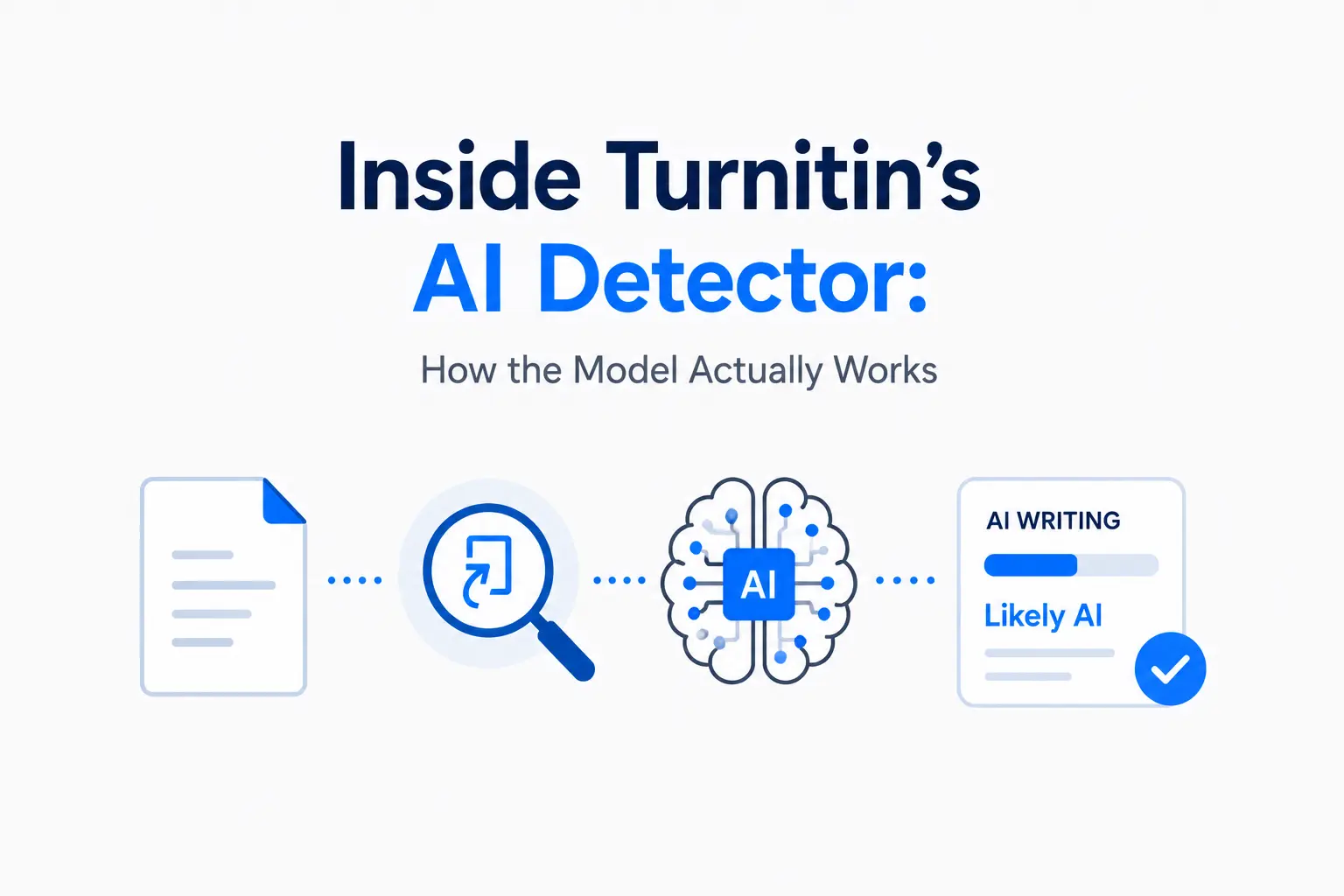
Turnitin's AI detector is not a single classifier. It is a pipeline of three models: AIW-1 (April 2023, trained on GPT-3 and GPT-3.5), AIW-2 (December 2023, retrained on GPT-4, Claude, and Gemini and extended to detect AI-paraphrased text), and AIR-1 (July 2024, the “bypasser” layer targeting outputs from humaniser tools, marked by the purple highlight). Our explainer on how the detector works walks through each layer.
The pipeline has genuinely improved detection of unedited output from newer models and has closed some of the QuillBot-style paraphrasing gap. What it has not done — and, given the underlying statistical approach, probably cannot do — is solve the false-positive problem for writers whose natural style shares surface features with AI prose. Every layer added to catch more AI writing also raises the risk of misclassifying human writing that resembles it. This is a design ceiling, not a bug to be patched in the next release.
When the score is worth taking seriously
The score is most reliable when three conditions hold at once: the submission is over roughly 300 words of continuous prose, the writer is a fluent native or near-native English speaker, and the text has not been heavily processed by a grammar tool, translator, or humaniser. In that window, a score at the higher end of the range (say, comfortably above 50%, and especially with AIR-1's purple highlighting) is a reasonable prompt to investigate further.
Even here, “investigate further” is the correct phrase. It is not “charge.”
When the score is not worth taking seriously
The score should be treated with real caution — and, in our view, should not be used as evidence at all — when any of the following applies:
- The writer is a non-native English speaker. The documented false-positive rates for ELL writers make the number unreliable at the individual level, whatever Turnitin's internal averages suggest.
- The submission is short, formatted, or technical. Below 300 words, in a methods section, in a lab report, or in writing dominated by equations, tables, and citations, the detector is operating well outside its published confidence range.
- The student uses Grammarly or a similar tool heavily. There is now consistent evidence that grammar-tool rewriting nudges text toward AI-like statistical profiles. See how Grammarly affects Turnitin AI scores.
- The score is under 20% (the *% band). Turnitin itself now hides these scores because of “a higher incidence of false positives” in that range.
What peer institutions have already decided
Perhaps the clearest signal that something is wrong is how many serious universities have quietly walked away. Vanderbilt's public statement in August 2023 laid out the arithmetic: even at Turnitin's claimed 1% document-level false-positive rate, their submission volume implied roughly 750 wrongly-flagged papers a year, and they judged that unacceptable. The University of Waterloo followed in 2025 after internal testing found the tool flagging genuine human writing as 100% AI. Johns Hopkins, Curtin University, the University of Cape Town, and several UC campuses including Berkeley have all either disabled the indicator or reduced it to advisory-only status. Inside Higher Ed and the Chronicle of Higher Education have both reported extensively on the retreat. Our own summary lists the institutions currently disabling AI detection and the reasons they have given.
None of these institutions is soft on academic integrity. They have concluded, on the evidence, that acting on the score does more harm than good.
The legal picture is changing
In February 2026, in Newby v. Adelphi University, a New York State Supreme Court judge ruled that the university's use of a 100% Turnitin AI score to sanction Orion Newby was “without valid basis and devoid of reason,” and ordered his record expunged. Newby had produced independent detector results and version history contradicting the score; the university had relied on the number alone. Similar suits are working through the courts against Yale and the University of Minnesota. The 100% AI score and falsely-flagged guides walk through the case in detail.
The instructor takeaway is straightforward. Acting on a Turnitin score without corroborating evidence is no longer just a pedagogical or ethical risk. It is increasingly a procedural and legal one for the institution.
What to do instead of relying on the number
If we set the score aside as, at best, a trigger for attention, what actually works? The honest answer is that the tools instructors already have are better than the detector.
Have the conversation. Ten minutes with a student — asking them to explain their argument, walk through their sources, describe why they made a particular choice — will tell you more than any percentage. Students who wrote the paper can talk about it. Students who did not, generally cannot.
Ask for the process, not just the product. Version history in Google Docs or Word, research notes, annotated PDFs, browser history around the writing window, earlier drafts — these are the artefacts of genuine writing and they are extremely difficult to fabricate after the fact. Requesting them is a light touch; refusing to produce them is itself informative.
Compare with prior work. If the student has submitted anything through the module — in-class writing, a reflection, a discussion post — you already have a stylistic baseline. Sudden discontinuities in voice, vocabulary, or argument sophistication are more diagnostic than any detector output.
Design the assessment so detection is not the last line of defence. An in-class component, a short oral defence, an iterative-draft workflow, a task grounded in local or personal material that generic AI cannot produce — all of these do more to preserve integrity than any detector can. This is the position the Chronicle and most teaching-and-learning centres have converged on.
The equity problem we cannot design around
Even setting aside individual cases, there is an aggregate problem that instructors should not ignore. The Stanford finding — that non-native English writers are flagged at rates over 60% while native writers are flagged at rates near zero — means that any policy of acting on Turnitin scores at scale will disproportionately harm international students, ELL students, and students from linguistic backgrounds under-represented in the detector's training data. This is not a hypothetical bias. It is a measured, reproducible one, and it lands on exactly the students who have the least institutional capital to defend themselves. Our piece on the language-support gap details what this looks like in practice.
An instructor who trusts the number is, in expectation, transferring the cost of a poorly-calibrated tool onto their most vulnerable students.
What institutional policy should require
A defensible policy does not need to ban AI detection. It needs to require corroboration. At a minimum, before any adverse finding, an institution should require:
- Independent evidence beyond the Turnitin score — typically a conversation, a comparison with prior writing, or documentation of the writing process.
- A written statement to the student of the specific basis for the concern, not just the percentage.
- A meaningful opportunity to respond, including the right to present version history, independent detector results, and other evidence. This is exactly the procedural failure the Newby court identified. Our appeal guide and reporting guide describe the process from the student side.
- Explicit recognition that non-native English speakers face documented elevated false-positive rates and that the tool's output on their work should be weighted accordingly.
Is it worth the harm it causes?
The uncomfortable question, in the end, is not whether Turnitin's detector works. It is whether the marginal cheating it catches — already reduced by the 15% miss rate the vendor concedes, and further reduced by anyone willing to lightly edit their AI output — is worth the false accusations it produces, the students it drives to spend their study time worrying about their statistical signature rather than their argument, and the institutional trust it corrodes when a paper someone wrote themselves comes back at 87% AI.
Reasonable people can disagree about where that line falls. What is no longer reasonable, given the evidence, is to treat the Turnitin AI score as if it were the answer to a question the machine has actually been asked to answer. It is not. Turnitin knows this and says so in its own documentation. The task in front of us is to make our practice, and our institutional policies, match what the tool can actually do.
Frequently asked questions
Should I use Turnitin's AI score as evidence in an academic integrity case?
Not on its own. Turnitin's own guidance explicitly states the score should not be the sole basis for adverse action, and the Newby v. Adelphi ruling in February 2026 confirmed that acting on the score alone can fail basic procedural standards. Treat it as a prompt to investigate, and build a case on corroborating evidence — a conversation, version history, comparison with prior writing, and where relevant a stylistic mismatch with the student's established voice.
How reliable is the Turnitin AI score in practice?
On unedited AI writing over 300 words in native English, independent testing puts accuracy in the 90–96% range with F1 scores around 0.92. On edited or paraphrased AI content the same testing sees accuracy fall to 40–70%. On writing by non-native English speakers, the Stanford HAI study measured a 61.3% false-positive rate. Short text, methods sections, and heavily formatted writing are all outside the tool's published confidence range.
Why have universities like Vanderbilt, Waterloo, and Johns Hopkins disabled AI detection?
Vanderbilt calculated that even Turnitin's claimed 1% document-level false-positive rate would produce hundreds of wrongly-flagged papers a year at their submission volume, and judged that unacceptable. Waterloo found internal test cases where entirely human writing was flagged at 100% AI. Johns Hopkins moved to an advisory-only policy after concluding the tool could not carry a formal misconduct charge. In every case the underlying reason is the same: the score is not reliable enough at the individual level to justify institutional action.
What should I do if a student challenges a Turnitin AI flag?
Give them a genuine opportunity to respond. Ask for their version history, drafts, and research notes. Have a substantive conversation about the argument in the paper. Consider running the text through a second independent detector as a sanity check — not because those tools are definitive, but because a stark disagreement between detectors is itself informative. If the student can talk fluently about the content and produce plausible process evidence, the responsible course is to close the concern.
Is there a defensible way to keep using AI detection at all?
Yes, but only as one signal among several, and never as the finding itself. A defensible workflow uses the score to identify submissions worth a closer look, then relies on conversation, process evidence, and stylistic comparison to reach an actual judgment. Assessment design that reduces the incentive to use AI — in-class components, oral defences, iterative drafts on personalised topics — does more for integrity than any detector output, and does it without the equity cost.
Ready to check your paper?
Get your Turnitin report in minutes.
Same report your institution generates — delivered privately, fast.